
What is Solipsism?
Have you ever felt like there’s a chance that everybody around you is a robot? Or that you’re the only conscious entity in a crowded room? How can you ever know for sure that your best friend isn’t a placed NPC in your life?
This psychological idea is known as solipsism. Solipsism is the concept that only one’s mind is sure to exist. It is the conclusion that external reality and other minds may not even exist at all. As the author, living behind my eyes and clacking away at my keyboard as I type this, I know that I exist. But how could I ever prove that you also have a consciousness in the same way I do?
Solipsism is like being isolated in a completely dark room and only being aware of your body’s natural output: your thoughts, your feelings, and sensory experiences. You are told that outside this enclosed room, there are other rooms with other people in them. However, you have no way of really knowing if this is true or not. While you are certain of your own existence, you are left uncertain about life outside the box.
What I just talked about is the extreme opposite of Sonder. As Sonder is the realizing that everybody has a complex life, solipsism significantly counters it by expressing that we could never truly prove this idea.
Counter to the Counter
I am the interchange of thoughts and feelings between individuals, creating emotional connections and a basic shared understanding. What am I? If you got the riddle right, you would know I am intersubjectivity.
Intersubjectivity highlights the mutual connection humans experience through interaction and communication. This link between individuals help you gain insight that other conscious entities are also filled with feelings and thoughts.
Intersubjectivty occurs constantly, whether you realize it or not. For example, think of a mom and a child. If the mother has furrowed eyebrows, a clenched jaw, a slight frown, and a “speak to me one more time and I’ll obliterate you.” voice tone, the child could most likely assume the mother is not in the happiest mood! Facial expressions and voice tones are types of expressions that helps individuals mutually become emotionally aware of the room, hence creating the foundation of shared understanding.
By creating the recognition of other lives and arguing for the interconnectivity of human experience, intersubjectvity effectively argues against solipsism.
Six Degree Theory
Did you know you can connect with any body in world, using a maximum of six links? I introduce you to the one and only Six Degree Theory. Let me further explain.
Introduced by Hungarian writer Frigyes Karinthy and tested by American sociologist Stanley Milgrim, the Six Degrees of Separation theory suggests that any two people on Earth could connect through a chain of acquaintances of no more than 6 links. So basically, your “friend of a friend” times 6 could hypothetically reach Putin or P. Diddy!
In Milgrim’s “Small World Experiment”, he aimed to investigate how connected the planet really is among the social network. In the experiment, participants from Nebraska (a rural area) were given a letter that was addressed to random person in Massachusetts (an urban area). They were told to deliver to letter to someone that somehow might be able to reach the person.
As the experiment ended, results were shown that it took an average of.. you guessed it.. six deliveries to reach the unknown person!
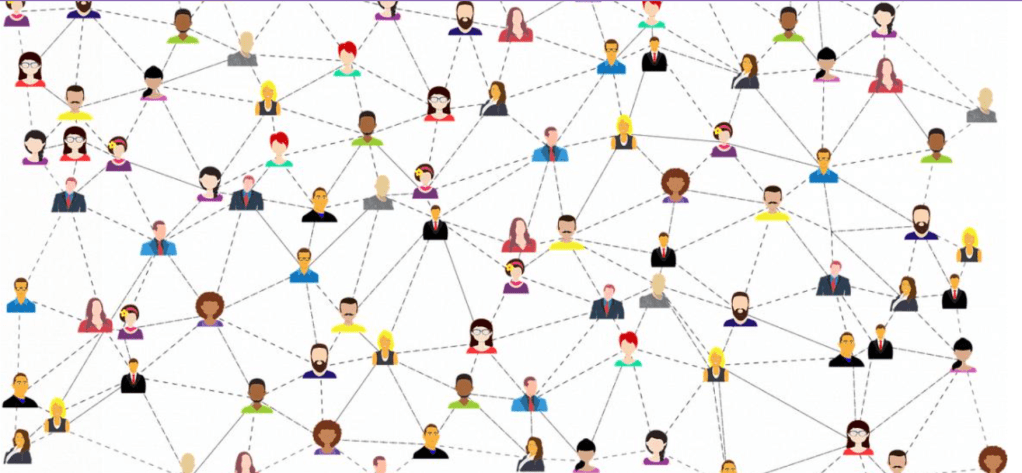
While this theory is not a 100% true, the significance of it portrays that even though there’s a variety of cultures and gaps between humanity, we are all part of a vast spider web.
While we are all unique in our own ways, as a society, we have a lot more in common than you think. 🙂
I love you, MegaladonTheRizzler2483 out.

 The Golden Thread
Leave a comment