
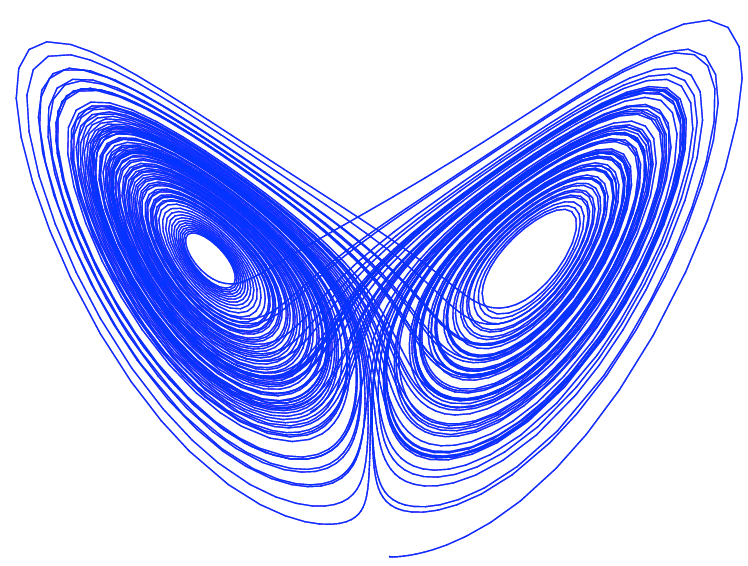
Exploring a concept that challenges our desire for predictability and how small changes can lead to massive consequences. Through the butterfly effect, I’ll explain chaos theory as an introduction to the establishing the paradox that, while we create theories to understand the world, chaos theory shows us how little control we truly have.
Small Wings, Big Storms
Picture this, a butterfly flaps its wings all the way in Brazil, potentially causing a tornado in Texas. This image captures the essence of how small, initial conditions can lead to vastly different outcomes, and is the reason behind why meteorologist Edward Lorenz in the 60’s coined the term “Butterfly Effect.”
In fact, Peter Dizikes from MIT in 2011 writes that the cause behind Lorenz’s discovery was the result of a quick coffee run. Specifically, “a result that would change the course of science” Dizikes explains that the discovery came by accident. While working on a computer system running weather prediction models, Lorenz returned from a break and noticed a minor difference in the input numbers that had led to a drastically different result.
What Lorenz stumbled upon wasn’t just an unusual coincidence, it was the foundation of what we understand today as “chaos theory.” Lorenz’s realization revealed that small changes in the starting conditions of a system, like the weather prediction model, can lead to vastly different outcomes. This idea not only transformed weather prediction but also laid the groundwork for studying how unpredictability shapes complex systems which brings us to the core principles of chaos theory.
How Does Chaos Theory Function?
So what are the core principles of chaos theory? Chaos focuses on understanding complex systems where small changes lead to unexpected results. This concept is all about the unpredictability within systems that may appear to follow clear patterns at first glance. Like a domino effect, chaos theory functions through small changes setting off a chain reaction that can completely transform the outcome of different systems.
Take weather for example. Like Lorenz in the 60’s, it might seem logical to think that we can predict the weather perfectly if we just know enough about current conditions. But chaos theory shows us that even the smallest error in a measurement can grow over time and make long-term predictions unreliable. It’s a reminder that some systems have limits to how predictable they can be, despite how well we study them.
Understanding chaos theory isn’t just about acknowledging this unpredictability that it presents, but it is also about recognizing that even in the face of disorder there’s often still something at work. It helps us see that while we can’t always know what will happen next, there will always be reasoning behind what we see. This changes how we think about trying to predict what will or wont happen.
The Science of Uncertainty
In all, you might be wondering what this means in the broader scope of the world. In “Why We Theorize,” I followed how humans create theories as a way to create a sense of control over the world and what we know. Chaos theory flips the view of scientific certainty on its head. It suggests that even in systems we think we understand, the future remains uncertain. The science of uncertainty isn’t about predicting everything perfectly, but understanding that unpredictability is a natural part of complex systems.
Chaos theory teaches us that the world is far more unpredictable than we might like to admit. It challenges the idea that we can control systems and instead reveals how the smallest changes can lead to large unforeseen consequences. Chaos theory reminds us that even in these systems governed by rules, unpredictability will always be at play.


 The Golden Thread
Leave a comment