
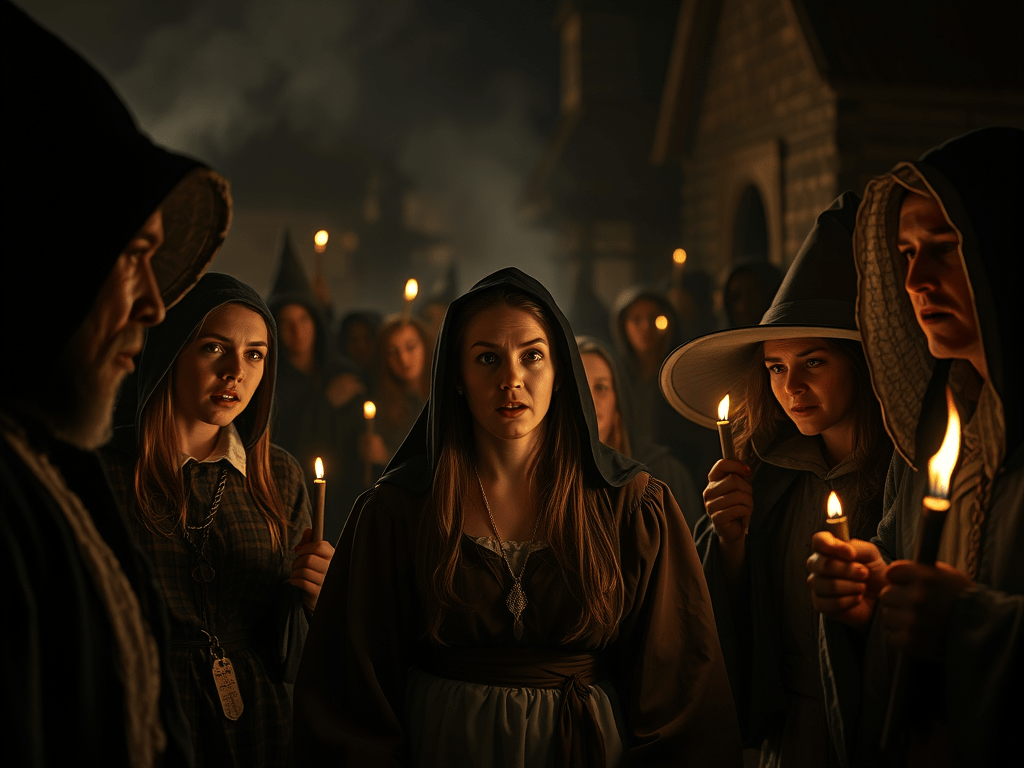
For many of my history classes, I assumed that the Salem witch trials were just another example of medieval superstition and an unfortunate event in human history where hysteria filled minds and innocent people paid the price. I imagined a world where fear of witches was simply a result of ignorance, and it was something that could never happen today. It’s often said that the Salem witch trials were driven by superstition, religion and a time when fear took over, and people were punished based on weak accusations. It’s commonly believed that events like these happened in a simpler, less advanced time, but what if it wasn’t just ignorance or religious beliefs that caused this? What if there’s more, a deeper sociological belief that has shaped not only the Salem trials but also many of the irrational fears and conspiracies we still see today? I never fully appreciated the role that conspiracy thinking, social dynamics, and belief systems can have on a community. What I once saw as a simple case of superstition is now a reminder of how easily mass hysteria can take hold in societies.
In the late 17th century, belief in witches and the power of the Devil was widespread, particularly in Puritan communities like Salem. The idea that witches could possess supernatural powers to harm others was tied to an influential religious belief system, where witches were thought to make deals with the Devil. Superstition played a huge role in the accusations. When something unexplainable happened like illness, crop failure or bad weather, witchcraft was the easiest thing to blame. Now these events are explainable, but back then these events created fear and panic. In Salem, collective beliefs were reinforced by a strong, close knit community, but this also led to an unwillingness to speak out against superstitions. The fear of witches became a shared belief that was difficult to stand up against. Hysteria spread quickly as group dynamics got stronger. Once witchcraft became a dominant belief. Every odd behavior or event was viewed as an act of the Devil. This kind of irrational thinking often spreads quickly, and individuals might act out of fear of exclusion or persecution.
A key aspect of the Salem trials was the belief in conspiracies. Many in the community believed that witches were part of a larger, hidden world working in secret with the Devil. Accusations were often conspiratorial ideas of widespread witchcraft against the community. In times of social or political trouble, people often look for someone to blame. The Salem witch trials occurred during a period of political instability and social upset. This contributed to a desire to identify “enemies,” real or imagined, and root them out, and witches were framed as internal enemies of the community. Religious leaders, who held significant power in Puritan society, were key influencers of the belief in witchcraft. Theocratic governance meant that the church and state were deeply intertwined, and religious authority was used to justify the trials. Figures like Reverend Samuel Parris and Judge Samuel Sewall legitimized the witch trials by supporting the accusations and contributing to the spread of paranoia.
Cognitive biases also played a role in the Salem witch trials. People were more likely to see connections between seemingly unrelated events, such as a sudden illness and an accusation of witchcraft, because of a natural tendency to search for patterns, even when they do not exist. Additionally, confirmation bias ensured that any new accusation was quickly embraced as evidence of a witchcraft conspiracy, while dismissing any arguing evidence. This made it difficult to stop the trials, as any challenge to the accusations was seen as a sign of siding with witches.
The sociology of irrational beliefs, superstition, and conspiracies directly shaped the course of the Salem witch trials. It helped explain how a community could be swept up in mass hysteria. The combination of deep religious beliefs, social pressure, group dynamics, and the tendency toward conspiratorial thinking created an unfortunate mix that allowed the witch trials to happen. The trials stand as a tragic example of how irrational beliefs and conspiracy thinking can spread and dominate a society, leading to devastating consequences.

 The Golden Thread
Leave a comment