
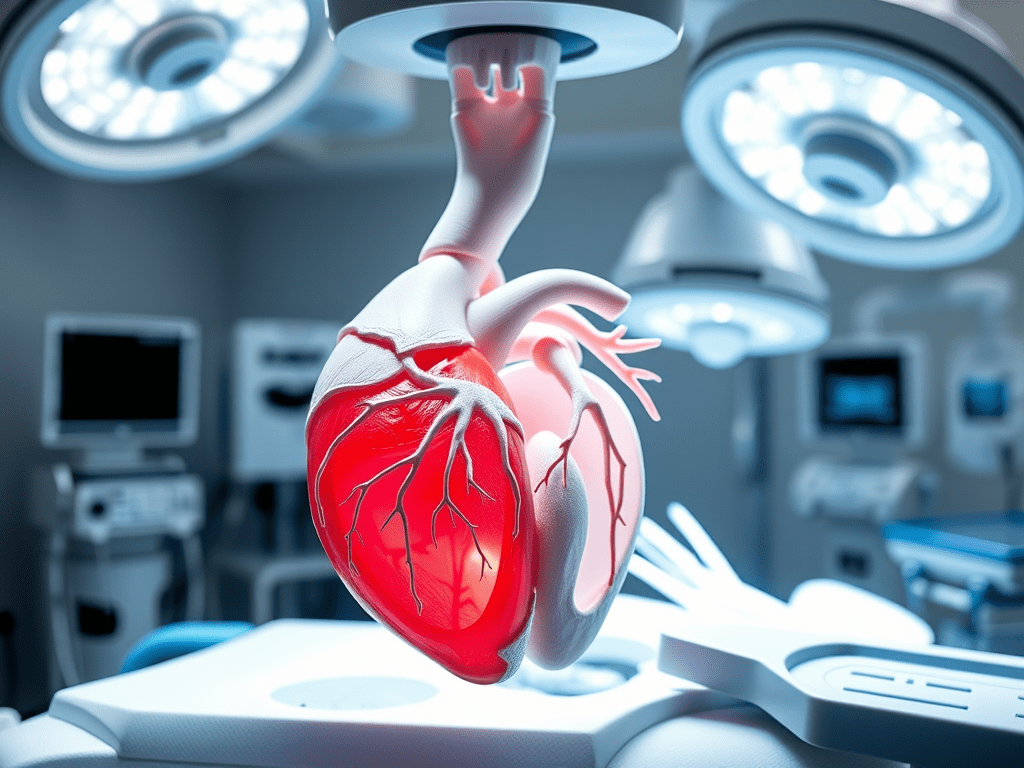
Imagine being able to hold a model of your own heart in the palm of your hand; every artery, valve, and chamber perfectly replicated in 3D perfection. This all sounds like fiction, yet, it’s the groundbreaking world of 3D printing in Cardio Thoracic Surgery, where technology is not just advancing; its revolutionizing how surgeons approach complex procedures. What once seemed like a dream for many surgeons is now a reality that is changing the future of heart surgery, offering hope to countless patients whose survival once depended solely on the delicate art of human hands. This new era of surgical technology precision has now arrived, where the power of 3D printing is reducing risks, enhancing recovery and potentially solving the most urgent medical crisis of our time- organ shortages.
The incorporation of 3D printing into cardio thoracic surgery is rapidly transforming the field, from reducing surgical risks through pre-operative modeling to create tailor-made heart valves and pro theses that quickens recovery. Scientists are even making strides towards printing functional heart tissue, which could one day resolve the critical shortage of transplantable organs.
3D Printed Models and Pre-Surgical Practice
Every heart is unique, with its own set of complex patterns and challenges. Traditionally, surgeons had to rely on 2D scans and their own knowledge to navigate this complex structure. But now, with the help of 3D printing, surgeons can hold a detailed, lifelike model of a patient’s heart before making a single incision. As highlighted by the research from the National Center for Biotechnology Information (NCBI), 3D models allows surgeons to rehearse and plan intricate procedures with unparalleled precision. ” The use of 3D printed models significantly enhances the ability to visualize and plan surgeries, thereby minimizing unexpected complications and improving patient outcomes”
This form of preparation reduces risks and boosts the confidence of surgeons, like rehearsing a speech before taking the stage. With 3D printing, the heart is no longer a mystery, it’s a well-rehearsed speech on a sheet of paper, with the words flowing smoothly as you speak.
Tailor-Made Prosthetics: The Revolution Of Custom-Fit Implants
Imagine you’re getting a custom-made suit, but instead of fabric, it’s made from materials that help your body heal. Now, picture your heart, ribs, or blood vessels needing special parts to work better or replace something damaged. Instead of using a one-size-fits-all approach, 3D printing creates a perfect, personalized fit for these parts just for you. According to another National Center Biotechnology Information article, these customized implants significantly improve both the fit and recovery process: ” The ability to create tailor-made cardiovascular implants has shown immense promise in improving the outcomes of cardio thoracic procedures.”
Tailored heart valves, from instance, don’t just fit-they bond with the body’s natural rhythm, speeding up recovery and reducing the risk of complications. The result shows a smoother path to recovery, a more harmonized fusion of artificial components with the human body.
The Holy Grail of 3D Printing: Functional Heart Tissue
The world of 3D printing doesn’t just stop at creating models and Prosthetics. In what might be described as the ‘holy grail of medical innovation’ scientists are now working towards the dream of printing functional heart tissue. If it succeeds, this could be a groundbreaking discovery that could potentially solve the global organ shortage. As noted in a recent study, “Research into 3D bioprinting of functional tissues is progressing, with heart tissue being one of the most anticipated areas of development.”
Essentially, researchers are not just printing replicas for organ; they’re aiming to create living, breathing tissue. This could one day make organ shortages a problem from the past- no more waiting for a donor, no more hope lost. A printed heart could be the ultimate lifeline, a beating organ engineered to perfection.
The Hurdles To Overcome
Yet, while 3D printing has brought cardio thoracic surgeons into the future, it’s not without it’s challenges. Some critics argue that 3D printing in medicine is too expensive or unproven, but costs are significantly dropping, and research is advancing. While fully printed organs isn’t possible yet, partial tissue replacements are already showing promise. Others worry that 3D printing implants won’t be as durable as traditional ones, but advancements in bio engineering materials have significantly improved their strength. As one study notes,” recent innovations in 3D printing have led to significant improvements in material strength.” So, while challenges remain, the progress made so far shows that 3D printing is becoming a reliable and affordable option for medical technology.
Dawn of New Age
Despite these challenges, the potential of 3D printing in cardio thoracic surgery is nothing but a project in progress. As technology evolves, so too deos our ability to perform heart surgeries with unmatched precision. Surgeons can now prepare more efficiently, patients recovery faster, and the dream of 3D printed hearts could one day be a reality that saves millions of lives. In the realm of cardio thoracic surgery, 3D printing is not just a tool; it is the technology of the future where precision meets humanity in the most inspirational way possible. The future has already begun, and it’s printed in precision.

 The Golden Thread
Leave a comment