

When school culture is brought up, some may immediately think about the student side of things; however, staff are often crucial in shaping a school’s community. Not only do they interact with students, mold the future generations, and keep track of tons of work, they do all this under the pressure of potentially toxic treatment by other staff or students, low pay, and other circumstances.
Workload Impact on Teachers
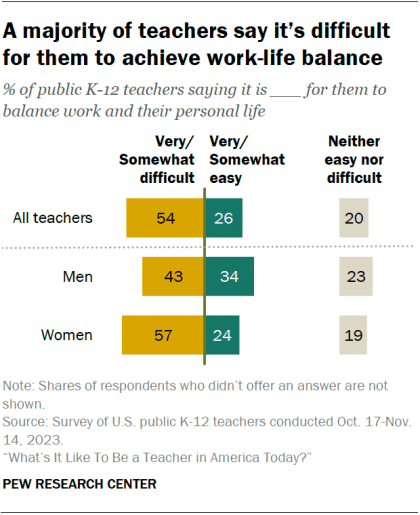
Teacher wellbeing is innately tied to how students learn and perform, as the teacher guides them, and cannot help others when they cannot help themselves. Sometimes though, it’s hard to help yourself when you have an extensive amount of work, limited time to complete that work, and have to consistently work overtime to keep up with assignments that need grading. According to Pew Research Center, most teachers said there wasn’t enough time to do all necessary tasks in the time allotted. Not to mention, teachers do this on top of managing their own lives, which as an adult can be stressful within itself.
Environmental Influences
These issues can be hard to fix, considering the lack of teachers found in many schools around the country. The number of schools feeling understaffed has fluctuated throughout the years, and while it’s steadily decreasing, there is a potential for this number to shoot up again due to federal changes in the education field.
Compounding this fact, pay for teachers has never been phenomenal, and many who would consider working in the field often leave because they can’t sustain themselves and potential families. Their base pay has often been seen as insufficient, and even as the years go on that salary rarely seems to improve unless you are hired into a more well-off school. The light at the end of the tunnel for several teachers seems to be retirement, as benefits are provided monthly and tend to support teachers well.
While they continue to teach however, staff should be supported and feel comfortable with their administration and higher ups. There should be open discussion on how to improve when problems occur, and even discussion when there is no conflict. Teachers opinion’s should be valued as they sit at the heart of the education field, but in several instances I’ve heard horror stories about how staff members are treated by management. Being heard is crucial, and feedback will go to understanding how to be a better school.
A Carrollton Perspective
As I was researching this topic, I interviewed several teachers around Carrollton in an attempt to get the full picture. They were told to be as honest as possible, so all confessions are anonymous.
Overall, the teachers believed that Carrollton tends to have a good school culture, although most agreed it could be improved. One even stated that our student body tends to be more tolerant than others, and there tends to be less peer pressure. However, several mentioned that they’ve heard students complain about this topic, and that they might not understand the full extent of the situation.
In terms of respect between staff, administrators, and students, all agreed they trusted and were respected by other teachers. When I asked about administration however, most seemed to pause and contemplate for a moment. Respect was not an issue they said, more so that they had occasionally bumped heads or had not seen eye to eye. One commented that the administrators were most likely doing their best, and that they and several other teachers had enjoyed more autonomy with the current management.
Most agreed that students did respect them, and those that didn’t were typically dealt with or simply ignored. One teacher in particular pointed out the educational differences influencing respect. Those in higher classes such as honors, AP, or IB tended to be more engaged and respectful compared to those in CP classes.
All had a different reason for becoming an educator, some more compelling than others, but all equally important. Following that, I inquired about if they would leave their jobs if another opportunity arose, and almost all immediately responded with a no. Although, I did notice that most of those who answered quickly were close to retirement, and they noted it was not worth it to switch careers now.
Contrary to what I expected, when asked if they regretted becoming teachers, all said no. I next asked if they would encourage others to become teachers as well, and besides one immediate “nope”, all seemed excited about certain students becoming educators. All essentially stated it would depend on the student, but we need more good teachers, and they would just have to be aware of the reality of the job in advance.
Crucial Opinions
Teachers cultivate school culture in an essential way, and while the cons of the job often feel demanding, these are the people that shape our entire future. It’s a piece of this confusing puzzle, and a perspective that offers an optimistic view on the student body when we might be overly critical of ourselves. However, it is just that, a piece. Everyone has a unique opinion on this topic and all sides should be analyzed, but for now, I can be content with the fact that our teachers seem to be enjoying their time at this school, and making a positive impact as they do.


 The Golden Thread
Leave a comment