

We’re constantly seeking efficiency. We crave solutions that are fast, cheap, and convenient; even at the risk of our own health or planet. A recent and prime example of this drive towards convenience is Artificial Intelligence (AI). You don’t need to read a book or scroll through Google to find answers to your questions anymore; you just ask AI, and it returns a simple and concise answer. You don’t need to complete your homework anymore; you just submit an image of it to AI, and it returns the answers. This may initially sound wonderful, as any knowledge you could possibly want is available through a simple prompt. However, the often overlooked consequences of AI suggest that our push for efficiency may be doing more harm than good.

At this point, AI is almost unavoidable. Even if you’re actively avoiding ChatGPT or Google’s Gemini, you’ll still be found victim to it by social media algorithms and even fast food drive-thrus. Despite its relative newness, it’s become so entangled in our everyday lives, and the worst part is: we can’t do much about it. AI is a force that’s here to stay, whether we like it or not. But before we fully accept it, it’s important to be aware of its downsides.
An issue I’m seeing brought up more and more with AI is its water usage. The data centers where AI models are processed require immense amounts of water to cool the systems and prevent over-heating. The water must be freshwater, as salt could corrode the hardware, but this means AI is cutting into our drinking supply. Only about 3% of the world’s total water is freshwater and even so, most of that water is trapped in glaciers and therefore unaccessible. This makes freshwater an extremely precious resource that we can’t risk wasting on AI.

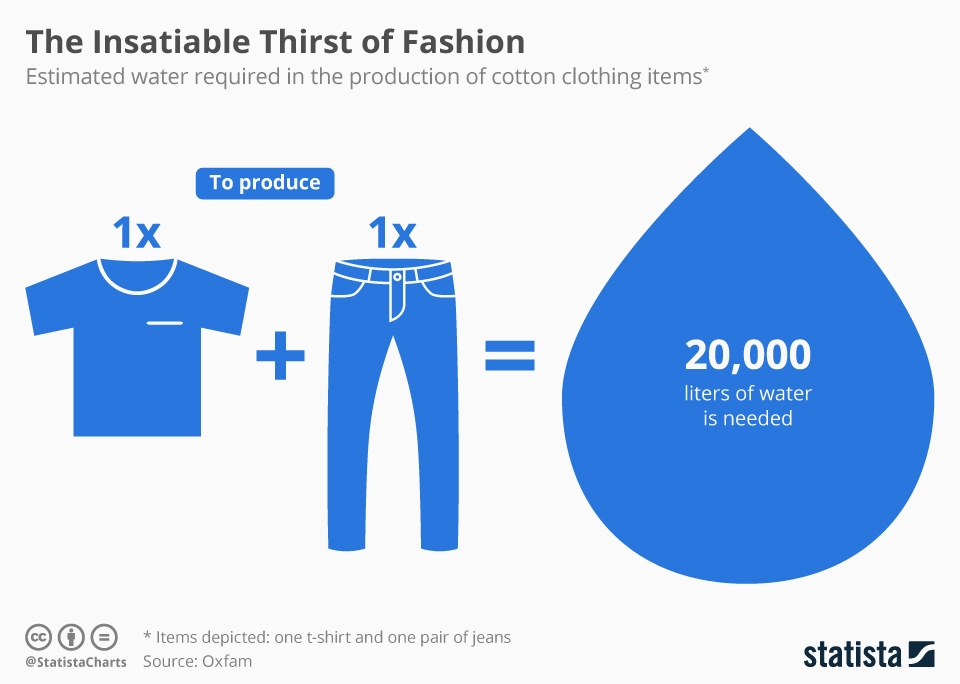
Similarly, the fast fashion industry also leans heavily on efficiency, but at a significant environmental cost. It’s focus on speed and cheap production requires massive water usage, as a single cotton T-shirt can use up to 2,700 liters of water to produce.
The push towards efficiency is not only affecting the planet, but also our values and how we behave. With both AI and fast fashion, we’re being conditioned to prioritize convenience over sustainability. We expect immediate answers and instant gratification. Why take the time to learn and research when you can just ask AI? Why spend the money to buy quality and ethically-sourced clothing when you can just buy cheap and trendy clothes?
The truth is, we can’t afford this luxury of convenience. Our plants can’t. Our animals can’t. Our oceans can’t. Our Earth can not afford this. But do we really have a choice? Every website you visit features an AI option; every store you enter displays racks of cheap clothing. Avoiding them feels impossible.
The sad reality is we’re stuck in a system that’s hard to break free from. The best we can do is to remain aware and push for change, hoping companies will one day prioritize the planet and not profit.

 The Golden Thread
Leave a comment