

The Korean conflict was the first war to involve jet combat from the onset. However, combat in Korea evolved dramatically over the years of the war. While early air combat saw largely uncontested success of UN forces in the skies, developments and aid from China and Russia soon turned the tide and created large scale battles between UN and communist forces.
Early War
When North Korea began the war against South Korea in 1950, United States and United Nations forces quickly stepped in. The US relegated Japanese-based squadrons containing P-51 Mustangs and newer jet fighters such as the F-80 Shooting Star into the fight. Ground attack aircraft such as the propeller powered A-1 Skyraider and the jet powered F-84 Thunderjet were used in close air support roles. For bombing, World War Two era B-29s and B-26s struck North Korean positions.
Both North and South Korean air forces were diminutive compared to allied forces fighting against North Korea. South Korea possessed only around thirty trained pilots and even fewer aircraft. North Korea operated a handful of Soviet propeller-driven fighters and ground attack aircraft. These virtually nonexistent air forces allowed for the Unites States to dominate North Korean airspace. Mustangs and Shooting Stars easily repelled any air to air resistance from KPAF (Korean People’s Army Air Force) fighters while ground attack aircraft struck important targets.

Nevertheless, the North Korean ground forces made incredible progress against United Nations and South Korean forces early in the war, so much as to push South Korea and its allies into a small territory near the port of Pusan. This was due to a series of oversights among ground-war strategists. Within a few months in late 1950, though, United Nations and Korean forces had pushed enemy forces nearly to China, before the border later evolved to the distinctive 38th Parallel that it is now.
Turning Tide
In late 1950, North Korea was supplied with the most advanced fighter aircraft in the world: The Soviet Mikoyan-Gurevich MiG-15. The MiG-15 was a radical change from conventional jet fighters of the time. Its swept wings and powerful engine gave it a cruising speed of 528 miles per hour, and a top speed of 669 miles per hour. It had impressive maneuverability and climb performance. Most intimidatingly, the MiG-15 featured two 23mm canons and a single 37mm canon. For perspective, F-80s were armed with six .50 caliber (12.7mm) guns. In a single one second burst of firing, an F-80 could shoot 7.34 pounds of ammunition. The MiG-15 fired 19.4 pounds of high explosive rounds. Worse yet, the MiG-15 was tremendously armored. American pilots reported accounts of firing massive amounts of ammunition into the MiGs, only for them to escape seemingly undamaged.

The MiG-15 truly shined in its intended role of bomber interception. MiGs could outclimb and surprise the B-29 Superfortresses that were once seemingly invincible during the Second World War. In an event known as ‘Black Thursday” to American pilots, thirty MiG-15s jumped a flight of nearly fifty B-29s escorted by approximately one hundred F-84s and F-80s. The MiGs shot down three Superfortresses and damaged seven others. No MiG-15s were shot down. Because of this event, allied bombing missions were stopped for three months in Korea.
Those flying the Black Thursday MiGs, and an estimated minimum of ninety percent of all MiG-15s flown in the conflict, were Soviet fighter pilots.
The Greatest Rivalry in Jet Combat
Scared into action by the unexpected domination of the MiG-15, the United States rushed its own new, advanced jet fighter into production: The North American Aviation F-86 Sabre.
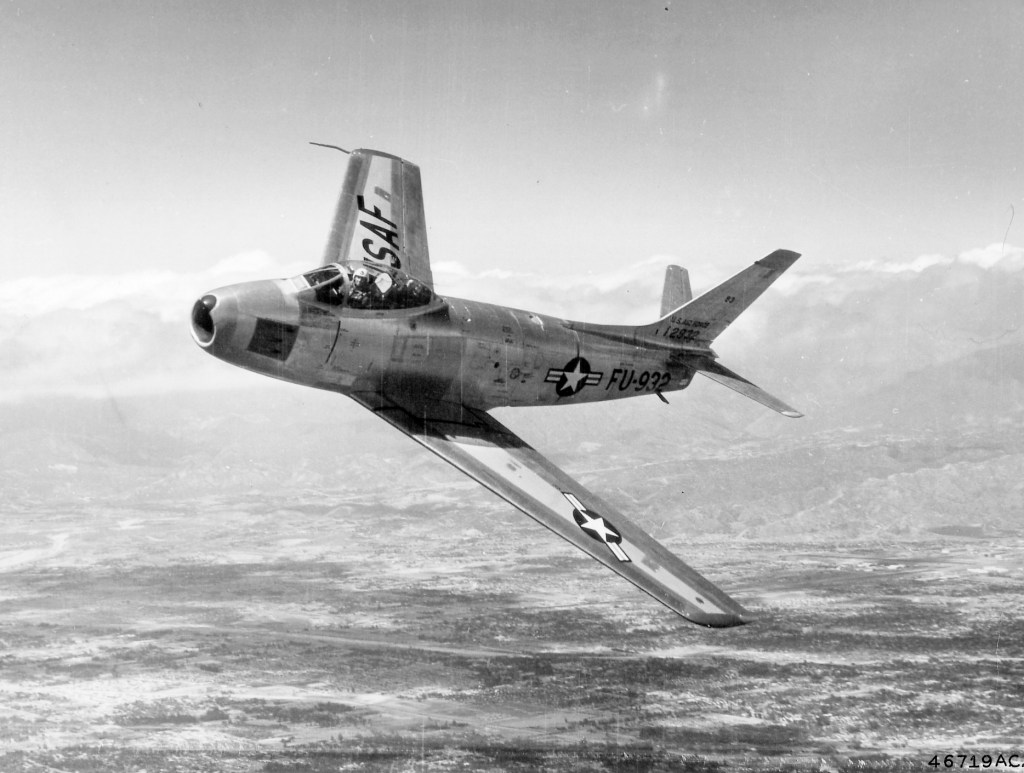
The F-86A Sabre’s introduction into Korea marked a turning point in the air war. Previously one-sided, the Korean air conflict now had equal competitors. The Sabre was slightly larger than the MiG-15, and had a slightly higher climb rate. However, the MiG-15 had superior firepower (the F-86 still used six .50 caliber machine guns), turning ability, climb rate, and service ceiling.
Sabre pilots still had in edge over the MiG pilots in the form of superior training. Even pilots of early variant Sabres claimed positive kill ratios over the Soviet aircraft, with some becoming fighter aces. In addition, the F-86 featured a gun-targeting radar in the nose, aiding pilots in aiming their smaller caliber guns against the MiGs.
Further refinements of the F-86 Sabre were introduced in later variants. The F-86F Sabre featured an all-moving tail, allowing it to safely maneuver in low supersonic flight. This was a weakness of the MiG-15. Although possessing a more powerful engine, the flight controls of the MiG-15 limited its top speed. Pilots were instructed not to exceed 0.92 Mach to prevent a phenomenon known as Mach tuck, where airflow over control surfaces become insufficient at high speeds, leading to a loss of control authority. All moving tail surfaces mitigated this issue.
F-model Sabres were also fitted with a more powerful engine, improving (but not eliminating) the advantage the MiG-15 held over the Sabre. The F-86’s hydraulic control system gave the aircraft a further advantage over its rival at high speeds, but the MiG still outclimbed the Sabre and had a maximum altitude advantage.
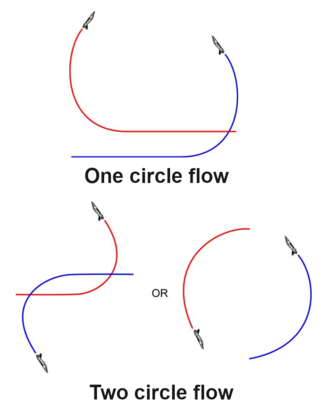
In a typical dogfight, the F-86 was likely to hold an advantage in a slow speed, one-circle engagement. The MiG-15 was prone to unrecoverable spins in a stall, and would have better used its advantage in thrust to fight the faster two-circle fight against the Sabre.
While the Sabre and the MiG held distinct advantages over one another, the skill and training of the allied pilots determined the success of the aerial war. The United States claimed a ten-to-one kill ratio againt MiG-15s with nearly eight hundred MiG-15s shot down and only seventy-eight Sabres lost. In contrast, North Korea claims over six hundred Sabre kills by MiG-15s.
Regardless of the exact number, the record reflects a story of a perfect rivalry in the air, and the last time that a Soviet and American fighter so closely matched one another in capability and design. The Korean War was the gateway into jet combat, and jet aircraft have only evolved further from these original designs since those days.


 The Golden Thread
Leave a comment