

Mosfilm Film Studio is the oldest film Studio in Russia, and one of the oldest in Europe. It was established after the October revolution and the Russian Civil War, in 1924. It is still operating today, unlike many studios from the same time. It has produced over 2500 full length films, many reaching over three hours. Mosfilm has won three Oscars for best international film over its history. It is impossible to talk about Russian movies without talking about Mosfilm.
When Mosflim first began in 1924, it was famous for montages. Sergei Eisenstein was the pride and joy of the studio. He earned many awards for his service to the Soviet union through his creation of propaganda films. His two most famous works are Battleship Potemkin, a dramatized version of the very really 1905 mutiny on the Prince Potemkin. It focuses on the brutal actions of the Tsarists in reaction to the mutiny. Eisenstein was an early film theorist. His works included montages to elicit an emotional reaction. He famously believed you could put two unrelated images side by side to create something new entirely.

In the 1930s, Mosfilm moved in a new direction. Musical comedies. Sergei Eisenstein had collaborated on numerous occasions with Grigory Alexandrov, but Alexandrov made far lighter films when left to his own devices. His films were influenced heavily by the west, and some even screened in the United States. Towards the end of this decade, Eisenstein had started on another epic, now on an ancient Russian prince.
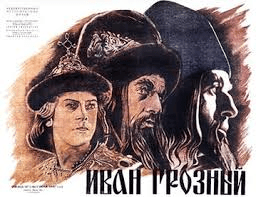
The 1940s were a tumultuous time for the Soviet Union and for Mosfilm. To talk about the films in this decade would be another beast entirely, so I will bring forward only two films. One from Sergei Eisenstein about Ivan the Terrible in the early ’40s. It was meant to be a trilogy, but Eisenstein passed away before the third movie was produced. The second movie was suppressed by Stalin because of its negative view of Ivan the terrible reign. In the late ’40s, Spring was released. It was the first movie to feature Mosflims famous logo. The fifties were much the same. Some of the greatest films of the decade were made to revise history, and to distract the public. The movie Fall of Berlin in 1950 characterizes this decade with its dramatic changes to historical events, and intensely positive view of Stalin. The film is considered one of the key examples of Stalin’s cult of personality. It was banned for decades after.
In the 1960s, Mosfilm produced War and Peace. It was incredible, and received many awards both within the country and internationally. In 1968, The Shield and The Sword was released and took the nation by storm. It launched Oleg Yankovsky’s career. It deserves an article on its own because there is no chance I will explain it succinctly. The 1970s is full of some of Mosflim’s greatest comedies, including Moscow Does Not Believe In Tears and Ivan Vasilyevich Changes his Profession. This is when we begin to see more western influence on Russian cinema. That does not mean the movies were better per se, but more western.

By 1980, Mosflim expanded its collection significantly. It had high grossing comedies, action packed adventure movies, science fiction adaptations, movies set on different planets, movies that poked fun at the government. Come and See (1985), Mosfilms greatest work, depicts the horrors of the second world war in excruciating detail, to the point ambulances had to be stationed outside certain theaters when it was screened abroad because people had such adverse reactions. But Mosflim did more. It made romances like Messenger boy. Assa, a fun holiday romance/ crime drama, was an allegory for the final years of the Soviet union, it brought rock onto the big screen. The now famous song ‘We Want Changes’ comes from this movie. It was experimental, it was dangerous, it was everything mosfilm wasn’t, but still it was.
Mosflim continues to produce films today. It has grown and changed and every era reflects the collision between the demands of the state, and the desires of the people. Mosflim created movies that pervaded every element of Soviet culture. Reality is grey. Cinema adds color. There is no better way to understand a people than to look at their art.
For more information see: Мосфильмhttps://en.mosfilm.ru
For more specific film summaries and recommendations: https://www.gw2ru.com/arts/2708-mosfilm-main-movies
To actually watch the movies: https://www.youtube.com/@Mosfilm_eng

 The Golden Thread
Leave a comment