

What is the Great Pacific Garbage Patch?
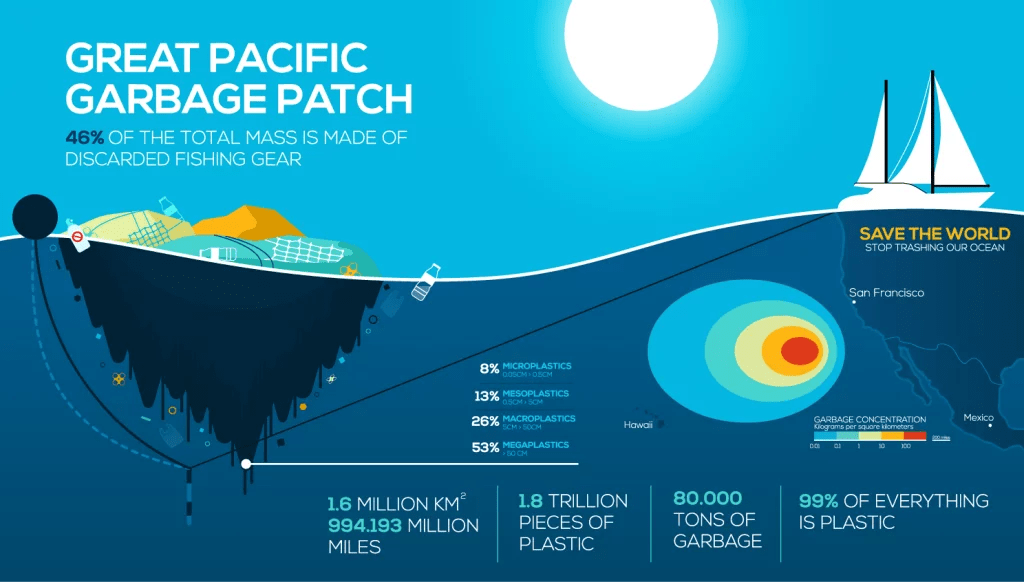
The Great Pacific Garbage Patch (GPGP) is defined as the largest accumulation of ocean plastic in the world. It is also identified as the largest of the five offshore plastic accumulation zones in the world’s oceans.
How did it form?
The Great Pacific Garbage Patch (GPGP) formed gradually over a long period. It is a result of marine pollution gathered by ocean currents, with the majority of plastic coming from land-based sources.
Impacts On Marine Life:
The Great Pacific Garbage Patch is a profoundly negative force on marine life. The accumulation of marine debris, particularly plastic, in the Great Pacific Garbage Patch (GPGP) poses significant and multifaceted dangers to marine life, affecting organisms from the smallest autotrophs to apex predators.
The primary impacts on marine life include ingestion, entanglement, chemical contamination, and disruption of the entire ecosystem and food web.
- Ingestion and Physical Harm
Marine animals frequently mistake plastic debris for food, which leads to severe physical complications.
Mistaking Plastic for Food According to The Ocean Cleanup, many animals confuse plastic for food due to its size and color. Some examples provided from National Geographic include loggerhead sea turtles often mistake plastic bags for jellies, which are their preferred food, also, albatrosses often mistake plastic resin pellets for fish eggs and feed them to their chicks.
Malnutrition and Physical Blockage Ingestion can cause choking, starvation, and other impairments. Chicks fed plastic may die of starvation or ruptured organs. The Shark Research and Conservation Program at the University of Miami suggests that ingested plastic can cause the mechanical blockage of the digestive tract, resulting in reduced food consumption or satiation of hunger.
2. Entanglement and “Ghost Fishing”
Physical debris, especially fishing gear, poses an indisputable entanglement risk to marine life.
Entanglement Risk National Geographic provides the facts that seals and other marine mammals are especially at risk of getting entangled in abandoned plastic fishing nets. Entanglement can also result from six-pack soda rings and other pollutants, according to the Shark Research and Conservation Program at the University of Miami.
Ghost Fishing The phenomenon known as “ghost fishing” occurs when lost or abandoned fishing gear continues to fish, wipe out resources, and entangle marine species, often causing them to drown.
3. Toxicity and Bioaccumulation
Plastics are vectors for harmful chemicals that can enter the marine food web.
Chemical Ingestion These chemicals can enter the food chain when the plastic is consumed by marine life. The Ocean Cleanup suggests studies found that 84% of plastics in the GPGP contain at least one type of Persistent Bio-accumulative Toxic (PBT) chemical. Animals consuming the debris are therefore ingesting these PBT chemicals attached to the plastic.
Bioaccumulation The Ocean Cleanup also suggests that through a process called bioaccumulation, these chemicals pass from the feeder animal to the predator, moving up the food web, potentially contaminating the human food chain as well.
4. Ecosystem and Food Web Disruption
Marine debris disturbs the entire oceanic ecosystem structure.
Blocking Sunlight National Geographic further supplies details that as microplastics and other trash collect near the ocean surface; they block sunlight from reaching plankton and algae below. Since algae and plankton are the most common autotrophs (producers) in the marine food web, threatening these communities can change the entire food web.
Apex Predator Impact If populations of animals that feed on plankton and algae (like fish and turtles) decrease due to a lack of food, there will be less food available for apex predators such as sharks, tuna, and whales (Details shown above are also provided from National Geographic).
Interference with Carbon Cycle The Ocean Cleanup discusses that microplastics interfere with the ocean’s natural carbon cycle, potentially reducing carbon export in the GPGP by up to 13 million metric tons per year.
Act Now
To conclude, marine life is affected significantly by the Great Pacific Garbage Patch. The marine life of the Pacific Ocean is constantly suffering due to the GPGP. This suffering includes choking, drowning, intoxication, etc. All this suffering is endured by our marine life for pollution that they’re not even a source of. The negative impacts of the GPGP are undeniable. One day, our whole ocean will be the GPGP if we don’t act fast. We should be taking care of our ocean and exploring its mysteries, not making it our dumpster! So, take initiative and help clean up our mess, for the sake of our ocean and the lives it contains.

 The Golden Thread
Leave a comment