
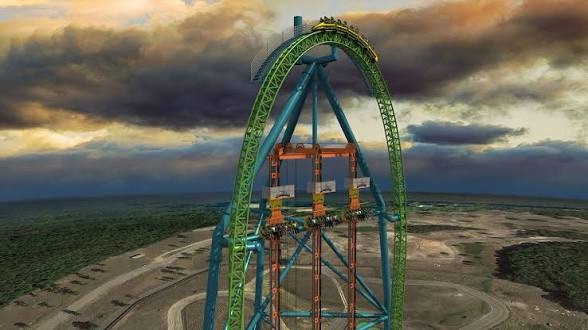
I have a confession.
I don’t feel the drop on roller coasters.
You know the one everyone talks about? The stomach-falls-out-of-your-body, heart-in-your-throat, life-flashes-before-your-eyes feeling?…Yeah, I don’t get that.
The cart climbs. Everyone starts screaming early. My best friend grabs my arm like we’re about to launch into space. We hit the top. There’s that dramatic pause.
We fall.
They lose their minds.
And I’m just sitting there like… oh. Okay.
I’ve ridden enough roller coasters to know I’m supposed to feel something dramatic. But my body just doesn’t react the way everyone else’s does. No stomach lurch. No rush of panic. Just awareness that we’re moving very fast.
And honestly? Watching everyone else has made me way more curious about fear than actually feeling it would have.
Because why do we love this?
Why are we paying to be terrified?
Let’s be real. Humans are weird.
We watch horror movies like The Conjuring and then complain that we “can’t sleep.” Every October, people line up to rewatch Halloween like being emotionally traumatized is a seasonal tradition. We go into haunted house KNOWING someone is going to jump out at us, and we still scream like it’s unexpected.
If fear is supposed to protect us, why are we activating it on purpose?
Fear is literally our brain’s emergency alarm system. It’s meant for survival. It’s supposed to say, “Hey! Danger! Run!”
But instead, we turned it into entertainment.
That’s kind of iconic of us.
I think its about surviving it
Here’s what I’ve noticed from the outside (because apparently I’m built different).
On the way up the roller coaster? My friends look miserable. Regret. Panic. Betrayal.
On the way down? Absolute chaos.
When it’s over?
They’re glowing.
They’re laughing. Out of breath. Immediately saying, “Again. Let’s go again.”
That switch is fascinating.
It’s not the fear they love.
It’s the relief.
It’s the moment their brain realizes, “Oh. I didn’t die.”
Your body floods with adrenaline when you’re scared. Your heart races. Your senses sharpen. And when it’s over, your brain rewards you for surviving. Relief hits. Dopamine kicks in. You feel powerful.
The difference between real fear and “fun” fear
Let’s clarify something: no one enjoys real fear.
No one enjoys accidents. Or loss. Or genuinely feeling unsafe.
The fear we love is controlled.
Roller coasters have seat belts. Horror movies have end credits. Haunted houses have emergency exits. There’s safety built into the system
Its danger-but with boundaries.
And I think that’s why it works.
We get the intensity without the consequences. We get to flirt with chaos and then go home and post about it.
It’s the thrill of almost.
Almost losing control.
Almost being in danger.
Almost freaking out.
Almost is exciting.
Researchers at Aarhus University found that enjoyment of haunted attractions follows an inverted U pattern. Too little fear produces boredom. Too much fear produces distress. Moderate fear produces the highest enjoyment.
People are not chasing terror.
They are chasing controlled intensity.
“Haunted House Researchers Investigate Playing with Fear.” APS Observer, vol. 33, 30 Nov. 2020, http://www.psychologicalscience.org/observer/playing-with-fear.
What its like not feeling the drop
For a while, I thought maybe I was missing something.
Fear seems like such a universal human experience. It bonds people. It makes memoires louder. It creates inside jokes.
When my friends scream on a ride, they grab each other. When its over, they replay every second of it. Fear becomes a shared story.
I don’t feel the physical drop, but I see what it does to people.
It makes them present.
For those few seconds, no one is thinking about school. Or college applications. Or what someone said about them. They’re just there. Completely alive.
Maybe thats what people are really chasing.
No fear.
Aliveness.
So why do humans love fear?
I think we love it because it proves something.
It proves our hearts can race and then slow down.
It proves we can panic and then breathe.
It proves we can face something intense and come out laughing.
Fear gives us a before and after.
Before the drop.
After the drop.
Even if I never feel that stomach-lurch everyone talks about, I understand why they keep lining up for it.
Because surviving something-even something small and controlled- feels powerful.
And maybe in a world where everything feels kind of repetitive and flitered, fear is one of the only things that still feels real.
Even if, for me, the drop never comes.

 The Golden Thread
Leave a comment