

What was the Spanish Inquisition in Relation to Francisco Goya?
Born in Spain in 1746, Francisco Goya was raised during a particularly violent time in Spanish history-the Spanish Inquisition.
The Spanish Inquisition was a judicial institution led by the Roman Catholic Church, whose primarily goal was to combat heresy, or the teaching of what the Roman Catholic Church deemed to be against its doctrine. The Inquisition was marked by particular cruelty to the accused, who had no rights and were tortured during interrogation, then usually convicted and executed or imprisoned for life.
The context of the Spanish Inquisition is necessary to understand how history affected Goya, and likewise his art, especially as it grows more twisted.
Goya’s Artistic Background
Goya started as a portrait painter, working for the royal tapestry factory, a position won for him by his wife, Madrid Josefa Bayeu, the sister of the top artist at the factory. He is a highly esteemed portraitist to this day, receiving several important commissions from highly respected individuals, and eventually becoming the court painter under Charles IV.
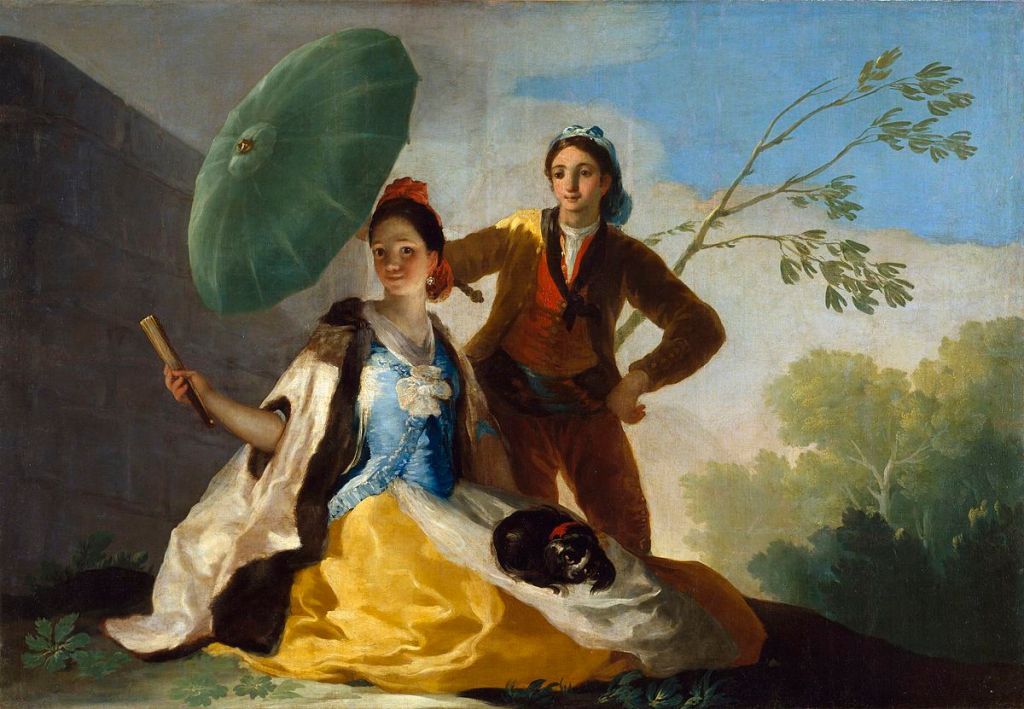
The above painting, The Parasol, Goya continues a series of oil on linen paintings he made specifically to hang in the Royal Palace of El Pardo. He didn’t make this painting for his own expression, but instead for a job.
Goya’s Shift to the Twisted
Then, around the end of 1792, Goya became ill with a still-unknown illness that left him deaf. He began to reevaluate his artistry, and his art subsequently became more and more pessimistic. His work began to feel less and less tied to traditional romanticism, the chief art form at the time, and more modern.
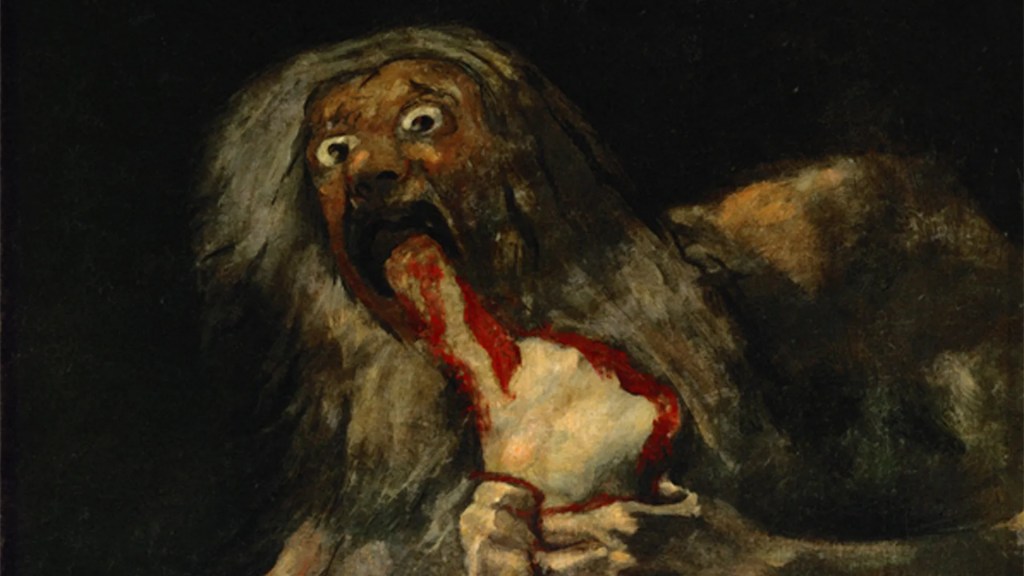
In the above painting, Saturn Devouring His Sons, was one of 14 “Black Paintings” done directly on the wall of Goya’s home between 1820 and 1823. It is a painting of a Greek myth in which Cronus, called Saturn by the Romans, devours his child in fear that the child will rise up and take power from Cronus. In this depiction, Cronus is seen to be acting out of calculated reason, not madness. This is a dark, twisted piece that perfectly encapsulates the madness in which Goya lived.
How the Inquisition affected Goya’s Art
So, how does the Spanish Inquisition affect this change? The answer can be seen in more of Goya’s art.

This work, There was no help, in a series of prints, depicts an accused heretic. The accused were paraded around on donkeys, wearing tall pointed caps, humiliated for all to see. Goya saw this as a cruel practice, speaking against it in his art. In this piece, Goya calls for someone, anyone, to help the poor uneducated soul being paraded to their death.
The Inquisition tormented Goya, and he used his art, especially later in life, to criticize the regime. He made several prints, one depicting the government as goblins, one depicting the common people as receiving little education, then being expected to know everything perfectly. He critiqued the aspects of the regime that were hypocritical, punishing people with death for an “incorrect” opinion, when they had no education to think differently.
It is easy to make the connection between the historical context of the Inquisition to Goya’s tortured motif and the ideas expressed in his works. Without the Spanish Inquisition and its cruelty, Goya might never have experienced such a tortured route, or made such twisted works.


 The Golden Thread
Leave a reply to micahchapmann Cancel reply