
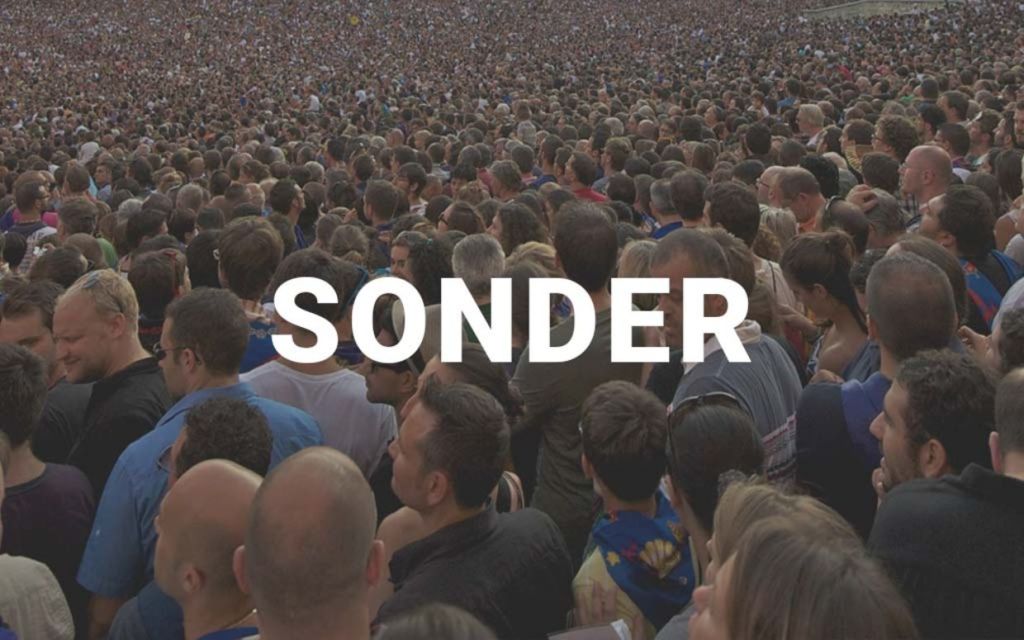
Sonder is the very thing lying under our nose that we constantly ignore. As the creator of this word, John Koenig defines Sonder as, “The realization that each random passerby is living a life as vivid and complex as your own.” Many people don’t realize it, but everybody has their own story. Surprise, you aren’t the main character!
Look around you. Cities, highways, airports, classrooms, restaurants. Quite literally anywhere. Each pair of eyes you see has their own journey, upbringing, stories, trauma, etc. When you go down a highway, those hundreds of cars you see are going to a certain place. Everybody has their own reason to be on the road at that exact same time as you are. What are the chances?
What is the Science behind Sonder?
Sonder has it’s roots inserted in you from the early age of 4. Around this age, one starts to learn about the “Theory of Mind.” This is the ability to understand that people have their own emotions, thoughts, and feelings. By being able to grasp other peoples’ perspectives, this is also the same age where kids learn to apologize.
During early childhood, kids start to develop the mental capacity to experience empathy for others. However, empathy is a only a mere building block of Sonder. To fully experience Sonder, one must feel mercy, compassion, and insight to fully be able to undestand the lives of others.
Social pyschologists study the field about how people think, influence, and relate to one another. They play a large role on the science behind the connections of people. The day to day life you experience consists of an experiment. For example, whether or not you know about somebody’s life events, this will determine how you treat them. Assuming you aren’t a sociopath, if somebody is experiencing a rough patch, such as the loss of a loved one, you will naturally treat them better. This relates back to the emotions of empathy and compassion.
But why? Why does this determine your treatment of others? The answer is clear. An effect of Sonder is putting yourself in another person’s shoes. You think you’re having a bad day? Can you imagine being a victim of revolting and gruesome crimes? Take Junko Furata as an example. This Japanese girl faced 44 days of a real life hell. From being kidnapped, beaten, raped, tortured, this is one of the most sickening cases in history. This automatically ties back to empathy.
Sonder also relates back to story telling. The interesting part about stories is when you listen to them, you imagine yourself first handedly experiencing it. Hence, the reacting emotions you obtain after. Ranging from excitement, jealousy, relief, anger, fear, admiration, and more, the extent to in what you feel relates to your insight on situations.
Why do we ignore it?
We tend to forget people have a life outside their role to us in our movie.
For instance, when I see teachers outside of school, I genuinely get terrified. Like what do you mean you do things other than teach me how Christopher Columbus sailed the ocean blue in 1492? (sick rhyme by the way) Also the remembering that my parents had a life before I was born stuns me everytime. Why?
As humans, we are living behind OUR eyes. Nobody else’s. We are isolated inside the dome we have on our shoulders. The only movie that is rolling constantly is ours. Sure, a few blips and ads will pop up, this being friends, family, or even random passerbys. But at the end of the day, you are the Sun and everybody else is a revolving planet.
However, we must not forget these planets have their own history. From how they came to be, to what they’ve been through, and to who they are today.
Everybody has their own baggage. Their own weight. And that must never be taken advantage of.
Be nice to your fellow planets. They are experiencing life for the first time, too.


 The Golden Thread
Leave a reply to mia Cancel reply