

The “blue note” of the of the F4U Corsair, its distinct whistling scream, inspired fear in the hearts of the Japanese during World War Two. The F4U, initially produced in 1942, spanned an eleven year production run until well after the world conflict ended, the longest of any fighter in the second world war. Although facing a troubled beginning, the Corsair was regarded as the most formidable foe to the Japanese forces and racked up a highly impressive 11:1 kill ratio.

The Birth of the Bent Wing Eliminator
The Corsair was designed in the early years of the war by Vaught-Sikorsky, and the first prototype of the aircraft was delivered to the U.S. Navy in 1940, before the Pearly Harbor attack ever happened that propelled America into the war. Even in its infancy, the Corsair was radical, incorporating unique innovations departing from traditional design to meet astonishing expectations.
Vaught-Sikorsky met the challenge proposed by the Navy in 1938 for a fighter with a maximum possible top speed and a stall speed lower than seventy miles per hour. By 1940, the first prototype Corsair, the XF4U-1, was delivered.
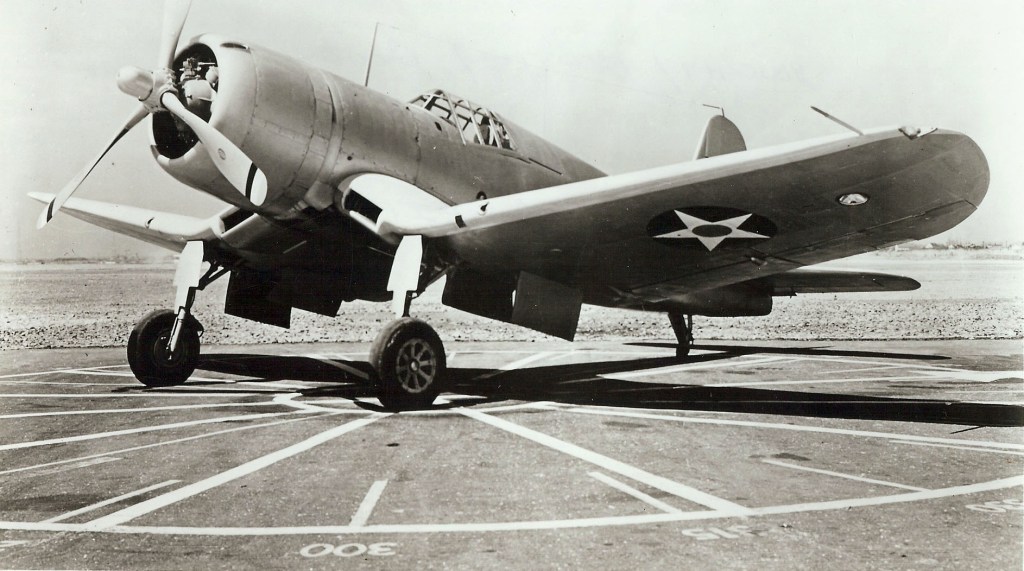
The XF4U-1 was the first aircraft to be designed for the Pratt & Whitney Double Wasp radial engine, which produced over two thousand horsepower (the P40 Warhawk, a 1938 American fighter, used an engine producing just over eleven-hundred horsepower). The prototype Corsair was the fastest and most powerful naval fighter ever constructed. It was the first American single engine fighter to reach a top speed of over four hundred miles per hour in level flight.
For such impressive performance, the Corsair used an unconventional design. To accommodate such a massive propeller, the Corsair featured an inverted gull-wing configuration. This anhedral wing root (the downturning of the base of the wing) allowed for increased ground clearance of the propeller while preserving the overall shape of the wing and accommodating the robust carrier adapted landing gear. Interestingly, while the construction of the curved anhedral wing root added weight, the positioning lowered aerodynamic drag.
Before entering service in 1942, several changes were made to the airframe. The initial armament of small caliber guns in the nose and wings were deemed insufficient, so three .50 caliber machine guns were fitted to each wing. This, however, reduced space for the fuel tanks in the wings. The only suitable place for the tanks to be moved was in front of the cockpit. This meant that the cockpit of the F4U Corsair was moved nearly three feet rearwards to an aft position on the fuselage, significantly impacting pilot visibility, especially on takeoffs and landings.
Control surfaces were changed as well: the ailerons were lengthened, thus shortening the span of the flaps. Much like aircraft of its ancestry, the Corsair featured some portions of the wings (namely control surfaces and outer panels) covered in fabric. In such a fast and advanced aircraft, this was unexpected. In other areas, advancements allowed for a smooth, non-riveted skin that decreased drag.
Growing Pains
When the Corsair first entered U.S. service with the Navy in 1942, problems were immediately apparent.
The aft position of the cockpit massively obscured taxiing and, fatally, visibility upon landing. Further issues with the arresting hook and oleo struts of the landing gear causing bounces on touchdown reduced the Navy’s confidence in the F4U for combat operations. There were aerodynamic considerations, as well. The Corsair’s left wing would stall well before the right wing due to the massive torque of the engine and the wash of the propeller. On a missed landing approach, the sudden throttle increase cost many pilots’ lives when the aircraft would snap roll onto its back and into the ocean. The wing design also made for more difficult spin recovery, and meant that deep spins would be impossible to recover from. For these reasons, the Corsair earned a nickname from pilots: the Bent Wing Widow Maker.
Although nearly perfect aircraft for Pacific combat, the Navy temporarily abandoned its Corsairs by handing them down to the Marines. It seemed that the raw performance of the plane came at too much of a cost to actual naval operation.
Simultaneously, the Navy was pushing to make the F6F Hellcat the standard fighter across its entire fleet. While lacking the performance of the F4U, the Hellcat was easier to land and cheaper to make; additionally, the Hellcat did a well enough job in the Pacific for the time.


Rebirth
Upon receiving the F4U Corsairs, the United States Marine Corps immediately saw success by operating them out of land based airstrips. Not only was the Corsair a high performance dogfighter, but a rugged and capable close air support fighter-bomber. During this time, the plane reached its incredible 11:1 kill ratio against the Japanese A6M Zero, and successfully carried out bombing missions on targets. In fact, the Corsair dropped approximately seventy percent of all bombs from fighter aircraft during the war. Its two stage supercharger gave the Corsair untouchable speed at a range of altitudes, and its resilient airframe allowed it to limp home under heavy damages. It was during these combat operations that the F4U earned its nickname from troops on the ground as the “Angel of Okinawa.”
The Corsairs outstanding compromise between power and ruggedness reflected an ever increasing evolution of combat aircraft throughout the war and into the modern day. It was one of the first truly multirole aircraft, capable of delivering devastating ordnance to ground targets and dominating the skies.

While abandoned for a time by the United States Navy, the British Royal Navy, much like the U.S. Marine Corps, had adopted the Corsair and seen outstanding success. With experience from the Hawker Seafire, the British Royal Navy developed a curving landing technique that kept a line of sight on the carrier deck until seconds before contact.
Using the knowledge from the British, and with some slight modifications, the Corsair reentered Naval service in 1944 to further overwhelming victories against the Japanese. By the time the war ended the aircraft had seen multiple evolutions, flown over sixty thousand sorties, downed over two thousand enemy aircraft, and suffered less than two hundred combat losses.
The Ascension of the Angel of Okinawa
Over the course of the war and after, the F4U saw many evolutions and modifications. These included changes to the canopy, gun armament, payload capability, endings performance, and general aerodynamic improvements. Many of these changes reflect the trend towards larger, more capable multirole fighters that excel at long range, high speed missions.
Of these changes, several were noteworthy. The F4U-1A variant was an early batch modification used by the British to make the aircraft suitable, or survivable, for carrier operations. It featured a modified canopy and raised seat for increased visibility, wings cropped by eight inches to decrease floating on landing, and various mechanical tweaks to eliminate previous carrier-ops issues.
The F4U-1D featured a more powerful water injected variant of its engine, increasing output by over two hundred fifty horsepower. Its six .50 caliber machine guns were replaced by four larger, twenty millimeter guns. While outputting more firepower and improving ground attack capability, many pilots preferred the original .50 caliber guns for dogfighting, as Japanese aircraft were dispatched just as effectively without the added weight penalty of the larger guns. The aircraft also received upgrades to allow for more payload to be carried for ground attack missions.
The F4U-4 was the ultimate Corsair of World War Two. It was fitted with a four bladed propeller and an upgraded engine pushing over two thousand four hundred horsepower. Discordantly with previous modifications, two wing fuel tanks were removed to increase maneuverability, while decreasing range. Top speed reached nearly four hundred fifty miles per hour, and service ceiling increased to above forty thousand feet.
After the war, Vaught consulted pilots to develop the F4U-5, the most powerful operational Corsair built. Engines were upgraded to two thousand eight hundred fifty horsepower, many automatic engine controls were added, the cockpit was redesigned, and the engine cowling was lowered for better visibility. The areas covered by fabric on the aircraft were replaced by metal.
Other, more exotic variants were built, including reconnaissance variants and even night fighters fitted with radars in the wings. One experimental variant featured two contra-rotating three bladed propellers, but was rejected by the Navy.

The legendary Corsair went on to serve valiantly in the Korean War as a fighter bomber, though outclassed by emerging jet fighters during the time. Still, it saw success as a close air support aircraft delivering attacks to targets on the ground. Amazingly, Marine pilot Captain Jesse Folmar shot down a (highly advanced for its time) MiG-15 fighter jet in his F4U Corsair in what was a daring act of heroism.
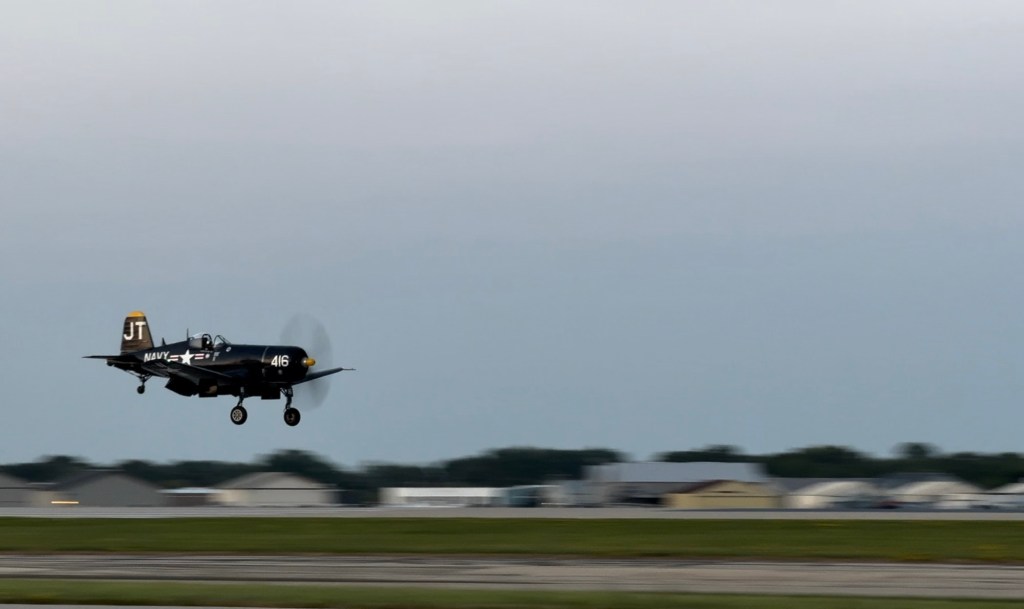
With the rumble of its eighteen cylinder Double Wasp engine and its terrifying whistle, a handful of F4U Corsairs still fly today as a reminder of its prowess as arguably the greatest naval fighter of the Second World War.


 The Golden Thread
Leave a reply to TerastalSpiceJNG Cancel reply