Synesthesia is a unique neurological condition that causes people to experience additional experience in response to a stimulus. For example, some of the most famous synesthetes are sound-color synesthetes, meaning that they see colors and shapes when they hear sound. This includes people like Billy Joel, Sibelius, Liszt, Billy Eilish, and many more. Sound-color synesthesia is one of the most well-known forms of the condition, but there are many more. There are more than 60 types of synesthesia, including many relatively unknown types.
When beginning my research, I wondered if my own experience with letters and numbers might fall under the umbrella of synesthesia. I read about many experiences of synesthetes who were surprised that the majority of the population did not see the world the same way they did. At this point, I had a sneaking suspicion there might be something a bit different in how I see letters and numbers. Ordinal Linguistic Personification is a type of synesthesia where ordered sequences like numbers, letters, days, or months are given consistent and involuntary human characteristics. For example, assigning genders and personalities to letters and numbers. I have always seen letters and numbers as having personalities and lives, and was actually quite confused when my mother could not see the worlds I had built with my letter magnets.
In an earlier blog, I went over how synesthesia has been influential in the arts since it provides unique perspectives of the world. In this blog, I will try to do the same, except on a much more specific, smaller level by describing my how my own worldviews have been affected by synesthesia.
How It Started
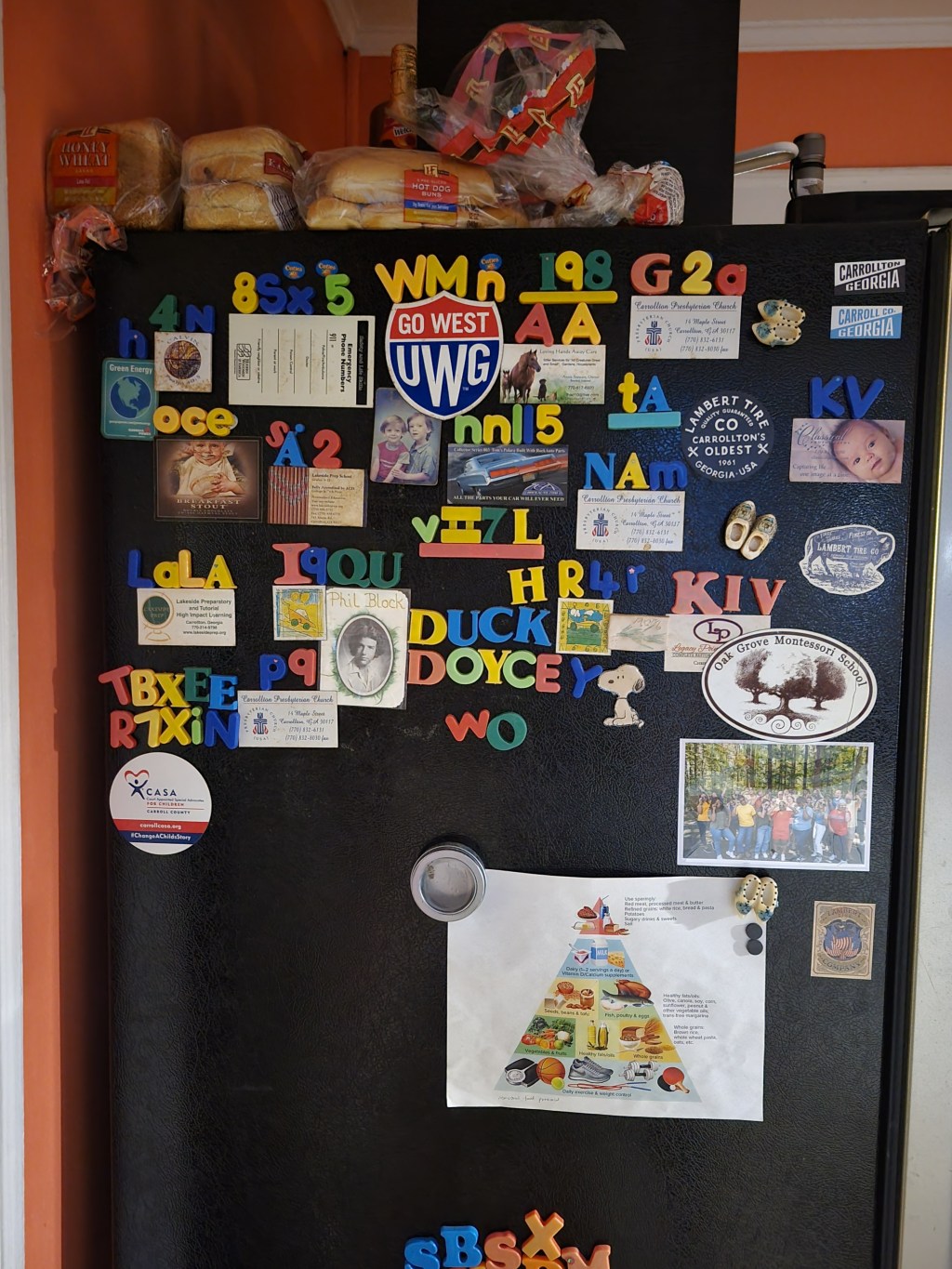
I first began learning my letters when I was almost three. My older brothers had left behind many traces of their own journeys of learning reading, including fridge magnets of letters and numbers. The fridge was crowded with pictures of past years, leaving few gaps for the letters. At first, my interactions with these magnets was small. I would put them in rainbow order, because that was the way I arranged anything at that age. Even in later years, there are still remnants of the rainbows, even if they now serve different purposes.

As I got older, how the letters and numbers were arranged became much more complex. Relationships and dramas began emerging, different societies formed, and family structures also began to become much more prominent. Still, the rainbows formed an early foundation of grouping the symbols and forming non-word structures with them.
Societies and Segregation
One of the earliest and most major movements that took place in the letters, so early that I no longer remember it myself but see it through pictures that have the fridge in the back round, was the separation of the smaller and the larger magnets. The large, more blob-like letters were move downwards into a clump that became reserved for my little brother to play with, because I was more interested in what the smaller letters were doing at the top. These letters began forming a town. Each picture or large magnet became a building that the letters lived in. These people lived in small units, usually just a couple and their young children, if they had any. The letters on the lower half were just clumped together. There were no pictures and magnets to serve as structures there, so I considered them a tribe similar to the Native American nomads I had been reading about at the time. At this point, there was no rhyme or reason to how they were arranged. I considered them simply “outsiders” from my main focus, which were the smaller letters that lived on the settled upper area of the fridge.
These two groups were not on friendly terms. Throughout the year I turned six, many major battles were waged along the border between the town and the forest that I imagined to be growing on the empty lower fridge. These skirmishes often lasted for weeks, because I had to imagine every battle from multiple points of view: those in combat, the strategists, the civilians, the medical teams. Of course, this only included the letters in the upper town. Being much smaller than their opponents, they had to smarter in combat. The main tactic of the lower tribe of letters was to group together and rush the defenses of the upper town forces. This simple and crude (or so I thought back then) tactic was apparently very effective in my mind; there were casualties galore on both sides, but mainly in the upper town. Still, the upper town always managed to pull off an unlikely victory. This showed how back then, I only knew concepts of the “good guys” who always won and the “bad guys” who always lost. Later, as I learned more about how both sides of a conflict always have a point of view and often there is no set “good guy,” many of these battles were revisited and made more complex, because now both sides had thoughts and feelings.
Societal Norms
In my observations of younger children I have played with or babysat, playing is a very important part of learned societal standards. Having toys and characters to play with allows children to test out their understandings of how the world works. For example, my little neighbor would often have one toy say something mean to another toy after he himself had been rebuked for saying something mean. Then the other toy might cry, or get angry, or rebuke the first toy for its cruel words. This allowed him to test life lessons within a safe space and experiment with social norms.
The letters served a similar purpose for me. A very memorable time period in my letter town was a time when the letters within the town became heavily divided. This happened to coincide with when I was first learning about the Civil Rights Movement, even though I never consciously made a connection between this real world event and what my letters were doing. Still, I believe that this is a good example of how I was testing the effects of segregation within a community. The smaller letters became divided into two groups: those with sharp edges and more petite frames, and those with rounded edges. The sharper-edged were separated from the rounder-edged letters. I didn’t really know what the reason behind the divide was, I just knew that there was one. This separation had devastating effects. Couples were split, children lost their parents, and shared businesses went down due to lack of cooperation. I believe that this little play that went on for only a few days on the side of my fridge helped me to better understand segregation in the real world.
Gender, Age, Personality
One of the things that was very involuntary on my part was seeing the letters as people, which meant seeing them as having genders, ages, and personalities. For example, this married couple below:
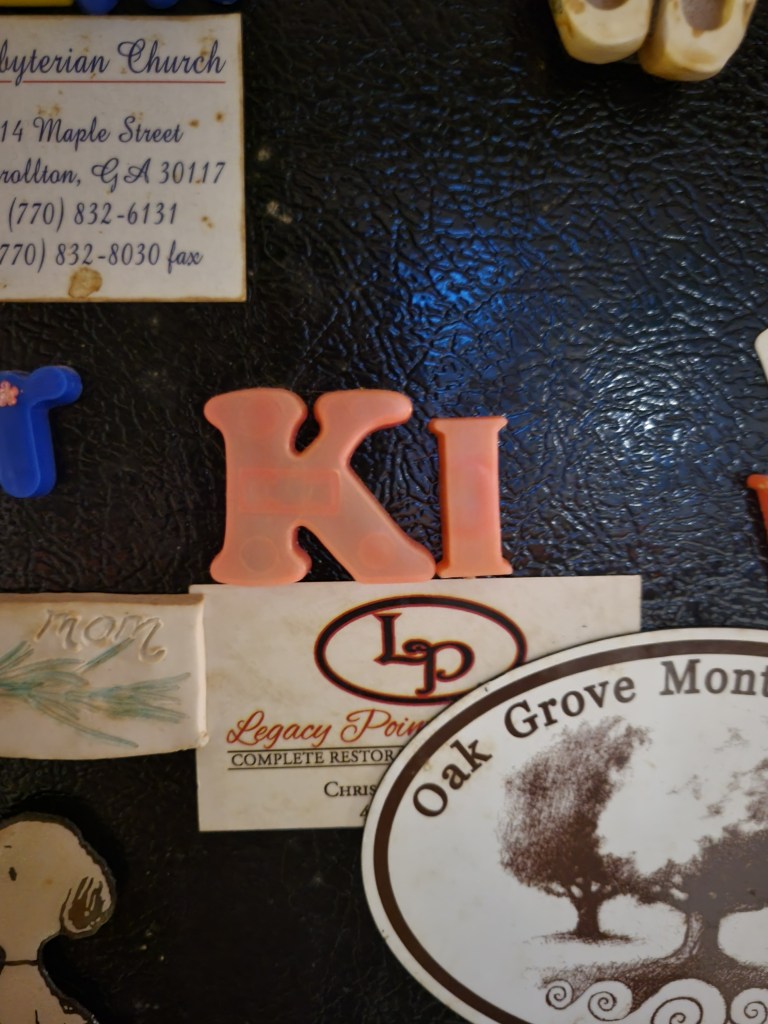
The pink K on the left is female, and the red I is male. Both are in their 80s. This couple is actually quite unique in that the wife is not originally from the upper town. For some reason, when my young self was separating the bigger letters from the smaller letters, this pink K remained behind in letter town and is actually the matriarch of the town’s leading family. Some of her descendants do share some characteristics of her tribal lineage, including the current Lady who is the leader of the town.
When I look at these letters, I instantly know them as an older couple of a warm, motherly figure and a more reserved, reverent old priest who has gone blind with age. This might be easier for non-synesthetes to understand, since the female letter is pink, which is commonly thought of as feminine, and the male letter is red, which is considered more masculine.
Another married couple might be a bit more difficult to see the way I do:

The small green V is the husband, while the taller green 7 is the wife. The husband is good-natured, kind, and cheerful, while the wife is much more snappy. This middle-aged couple does not have any children, and owns the general store in town. Customers respect the snappy but secretly kind wife, but often prefer to joke and small-talk with the good-natured husband.
However, gender is not necessarily very simple in this world of the fridge. While most letters are very clearly and consistently male or female, there are a few exceptions. Ys and certain Os, with a few Qs that lack defining characteristics, are all a bit more difficult to define, like the ones below:

The green O is very clearly male, and the orange O is male but less distinctly. The yellow Q is ambiguous, even though the other Qs on the fridge are pretty easily either male or female. For example, there is a Q that looks exactly like the green O, except with a small tail. This Q is distinctly female despite its similarity to the distinctly male green O.
The red Y is a special case. At first, before I began paying more attention to the letters on the lower fridge, this Y was male pretty much by default, because it was red. However, as I began to look closer at the tribe of letters on the lower half of the fridge, this Y ended up being female. To explain this change to myself, I decided that the emphasis on combat skill in the tribe meant that oftentimes female children were raised like males. However, with so many people focusing on their skills rather than having children, there were few marriages and even fewer children. To remedy this, the leaders began having these more masculine women become more feminine and begin looking for partners. This is an example of how my own perception of the letters affected the social norms in the societies they were part of, and also how there are exceptions to first impressions of letters if the assumptions are based on something like color.
I believe that these exceptions existing in my imaginary letter world made me more open-minded when learning about other gender identities in the real world, because just like the real people, the letters were simply made that way, with exceptions to the usual two genders that they did not choose, but simply are.
The Stagnant Letter World
There is much, much more I could say about the letter world. For example, compatibility, laws, traditions, the afterlife, the various dramas that have gone on in the town, but since every single letter has a vibrant and complicated life, how could I even begin? The letters do not have names in a usual sense. They have names for each other, but I don’t know them. How can you give a human name to a person who is a letter, not human? This makes it even more difficult for me to share my little magnet world, because even if the letters are people, they aren’t human.
As I have gotten busier over the years, I have less time, energy, and memory to continue the stories I have made. The letter world has become stuck in time. Without the constant attention it used to get, the letters town has also lost many letters to the cat and the little children who don’t see the complex society as they take the letters and lose them. Even so, I can’t find the will to take the letters down into storage. How can I destroy a world that I have been building for more than 10 years? This world has had an important impact on my life and how I see the world, with a bit of help from synesthesia.


 The Golden Thread
Leave a comment