
What is the Deepsea Challenger?
The Deepsea Challenger is a submersible built for explorer James Cameron to conduct scientific research in the world’s deepest oceanic trenches, particularly the Challenger Deep in the Mariana Trench. James Cameron was not the first to go down to the Challenger Deep, but he was the first single diver, and his dive was completed successfully with the Deepsea Challenger.

Challenger Deep
The Challenger Deep is its deepest section of The Mariana Trench, and the ocean all together, reaching approximately 36,000 feet (around 11,000 meters or 7 miles). It is characterized by extreme pressure (over 1,000 times that at the surface), near-freezing temperatures, and total darkness. Despite these harsh conditions, life has been found to exist, including unique organisms and even pollutants. The Deepsea Challenger is a one of a kind piece of technology that has helped us see the deepest parts of the ocean. It has unlocked many discoveries and has helped us move forward on uncovering many mystery’s about our ocean.
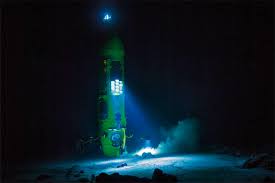
Size and Shape
The human-occupied vehicle (HOV) DEEPSEA CHALLENGER is notable for its unique size and shape, particularly its vertical orientation.
- Size:
According to Woods Hole Oceanographic Institution, the vehicle is 24 feet long (7.3 meters), and it is described as weighing approximately 11.8 tons.
- Shape and Structure:
The Woods Hole Oceanogrphic Instintution also states that the vehicle features a unique vertical orientation in the water. This design enables the sub to descend and ascend rapidly through the water column, which maximizes the time the crew can spend on the bottom and allows the sub to be recalled quickly if surface weather suddenly worsens. The submarine has 12 thrusters for propulsion, this helps the sub get deeper than we have ever been before with a single diver.
Systems and Technology
The technology developed for the human-occupied vehicle (HOV) DEEPSEA CHALLENGER represents a series of remarkable technological breakthroughs designed to overcome the extreme challenges of full-ocean depth, significantly advancing scientific access and discovery in the deep ocean.
The technological innovations embodied in the vehicle have led to major advancements in how deep-sea exploration is conducted, particularly by allowing the collection of high-quality data and samples over extended periods.
- Structure and Flotation:
Both Woods Hole Oceanographic Instintution and National Geographic support that approximately 70 percent of the vehicle’s volume is made of a patented, highly sophisticated syntactic foam called ISOFLOAT™. This foam provides both buoyancy and structural support capable of withstanding crushing deep-ocean pressures.
- Pilot Sphere:
The steel personnel sphere is 2.5 inches (6.4 cm) thick ,according to Woods Hole Oceanographic Institution, and was tested to withstand full-ocean-depth pressure of 16,500 pounds per square inch.
- Ascent Mechanism:
The National Geographic Systems and Technology website supports that; descent relies on over 1,000 pounds of steel weights held by electromagnets. And to ascend, the pilot jettisons these weights. Backup weight release systems include power failure triggers, acoustic commands from the surface, and a frangibolt mechanism.
- Imaging and Lighting:
Woods Hole Oceanographic Institution suggests that the sub incorporates a high-quality video imaging system capable of producing 3-D movies of the seafloor. External lighting includes a seven-foot (two-meter) panel of LED lights, this is stated by both Woods Hole Oceanographic Institution and National Geographic.


 The Golden Thread
Leave a comment