
High fuel consumption, non-durable infrustuctures, and the super sonic boom led to the end of the Concorde. The legendary jet was a huge aviation accomplishment, but its commercial viability was its downfall. However, we may be approaching a new chapter in aviation. A new fleet of quieter, more sustainable supersonic jets is coming up, promising to overcome the challenges that made the Concorde fail. This time, it will be about smart, quiet, and profitable supersonic travel.
XB-1
Now, 50 years after the Concorde, “XB-1, the world’s first independently developed supersonic jet, took flight at the Mojave Air & Space Port in Mojave, California on March 22, 2024. XB-1 was flown by Boom Chief Test Pilot Bill “Doc” Shoemaker, and Test Pilot Tristan “Geppetto” Brandenburg flew the T-38 chase aircraft which monitored XB-1 in the air. Now that XB-1 has successfully completed its first flight, the team will systematically expand the flight envelope to confirm its performance and handling qualities through and beyond Mach 1” as stated by Boom, an American aerospace company, creating these new supersonic jets. The XB-1 is the prototype jet made by Boom and it’s goal is to be a safer, smarter, and more cost efficient supersonic airplane than the Concorde ever was.
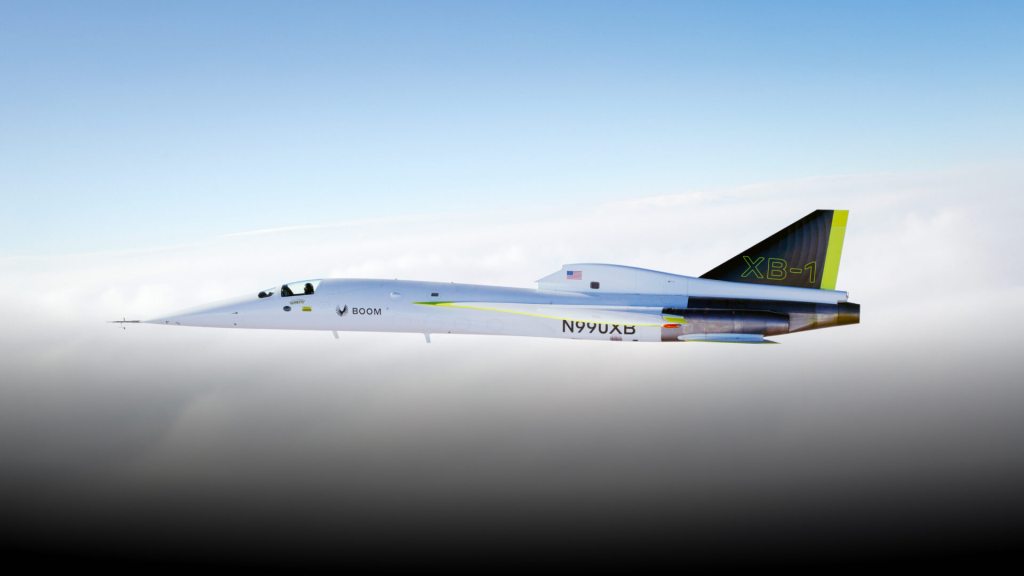
A few new technologies added to the XB-1 is; an augmented reality vision system, digitally-optimized aerodynamics, carbon fiber composites, and supersonic intakes. The augmented reality vision system is made up of two nose-mounted cameras, digitally augmented with attitude and flight path indications, that feed a high resolution pilot display enabling excellent runway visibility. This system enables improved aerodynamic efficiency without the weight and complexity of a movable nose. For the digitally-optomized aerodynamics engineers used computational fluid dynamics simulations to explore thousands of designs for XB-1. The result includes an optimized design that combines safe and stable operation at takeoff and landing with efficiency at supersonic speeds. For the carbon fiber composites, XB-1 is almost entirely made from carbon fiber composite materials, enabling it to realize a sophisticated aerodynamic design in a strong, lightweight structure. And lastly the supersonic intakes: XB-1’s engine intakes slow supersonic air to subsonic speeds, efficiently converting kinetic energy into pressure energy, allowing conventional jet engines to power XB-1 from takeoff through supersonic flight.
Overture
The achievements of Concorde remind us that supersonic travel is possible. Overture highlights that supersonic travel for passengers is not just in the near future, but it’s both economically viable and environmentally sustainable. Overture is a future supersonic airliner who will be partnering up with United Airlines, American Airlines, and Japan Airlines to provide the best supersonic travel. According to Forecast International, an aerospace analytics company, says, “Boom Supersonic’s Overture is a high-speed commercial airliner designed to cruise at Mach 1.7 and reach altitudes of up to 60,000 feet. Capable of flying twice as fast over water and up to 50% faster over land than conventional aircraft, Overture offers a maximum range of 4,250 nautical miles (4,888 miles / 7,867 km) and will serve over 600 profitable routes globally. The aircraft measures 201 feet in length and is designed to carry 64 to 80 passengers in an all-business class configuration. The Symphony engine, which will power Overture, is also planned to be 100% sustainable aviation fuel (SAF) capable. Additionally, Boom is developing “Boomless Cruise” for Overture.”
These are all wonderful things that Boom is doing with Overture, with including things like “Boomless Cruise” to prevent any supersonic boom, and making it SAF capable to ensure less harmful chemicals and gases enter the atmosphere. These are great things, happening in the future for supersonic travel but there is much more to overcome.
References
Holve, G. (2025, August 25). Boom Supersonic – Overture Airliner Program Outlook. Flight Plan. https://flightplan.forecastinternational.com/2025/08/25/boom-supersonic-overture-airliner-program-outlook/
Boom Supersonic (2024, April 18). Flyby – the revival of Supersonic Travel. https://boomsupersonic.com/flyby/the-return-of-supersonic-travel


Leave a comment