
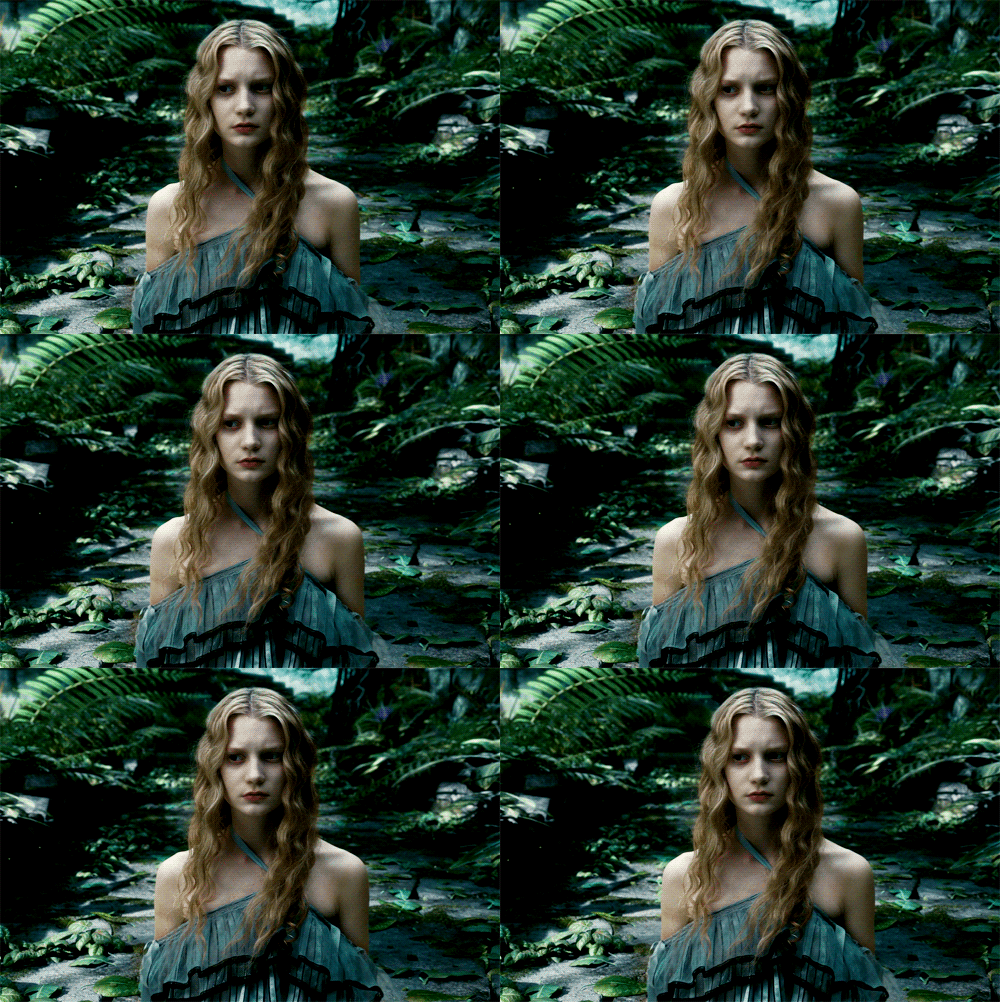
We’ve all had a dream that latches onto our mind, body, and senses long after the sun comes up. It makes you feel as though those dreams hold meaning, especially when those dreams return, day after day, night after night, in an almost haunting manner. What happens when those dreams bleed too far into reality and affect each and every aspect of your life? Did Alice slip too far into a doze, or was she a young girl with a knack for colorful imagination?
There are many individuals who prefer life with their own made up thoughts and beliefs, a world being intricately placed in a way that excites them. This often leads to insanity due to it being mostly negative for you as a person, but addicting when you get to repeat those highlights again. Unfortunately, once a dream lingers there for a while, it becomes a parasite. You see, when the allure of your own fantasy sounds more intriguing than the bore you live day-to-day, you tend to turn reality into your vivid hallucinations. By this point, you’re not longer inside of dreams, for you have forced it to become your daunting reality.
While you can fix addictions and get out of the hole you fallen down, you will forever have a tainted memory of what happened. Once you have seen the alternative, it’s nearly impossible to accept the reality that feels grey, dull, and meaningless. This is where the fine line between whether or not it was a dream or insanity comes into play. Personally, I feel as though people are over-analyzing the story. I tend to remember a ton of my dreams, and it’s gotten to the point where I can write essays on them, so the argument of Alice possibly having some sort of syndrome is nonsense. However, the belief that dreams can take over how you view the world around you is very much true. If the narrative didn’t visualize Alice waking up, this could’ve been a way of including mental disorders which could’ve also been very enlightening to some parents who read/watch Alice in Wonderland with their children. Beyond that, I truly don’t see anything wrong with a child being momentarily lost in the dream; it’s only a concern when that child doesn’t wake up from it.
I believe that by viewing Alice as a ‘mental case,’ we minimize the abstracts of the human mind. Specifically, the human mind of a young child. Children are very imaginative. Two different children can look at the same rainbow and decided what it portrays whether it means that unicorns exist; to the other, dragon will soon be apart of our earth. It is crucial that the human mind be able to see different ideas and experiences that are much more powerful than the grey of our reality.
I guess you could argue that the human mind’s ability to find a way to turn everything into a theory is, in itself, a form of the mind be abstract and unique.
In the end, if ‘sanity’ is defined by rules and logic, then Alice’s journey through Wonderland is a way of showing how the mind doesn’t follow the ‘code’ of life. It illustrates that the human mind can force you into a world of wonders, where someone can determine what that shows about you. Dream or not, this is why the importance of creativity is fundamental when reading a book like Alice in Wonderland. The real world isn’t made for dreaming, it’s made of duty. It’d be a misery to deal with day by day without a small reminder to slow down and imagine. The ‘fine line’ isn’t the point where everything finally makes sense; it’s where everything can be questioned and where wonder truly exists.


 The Golden Thread
Leave a reply to Claire Edwards Cancel reply