
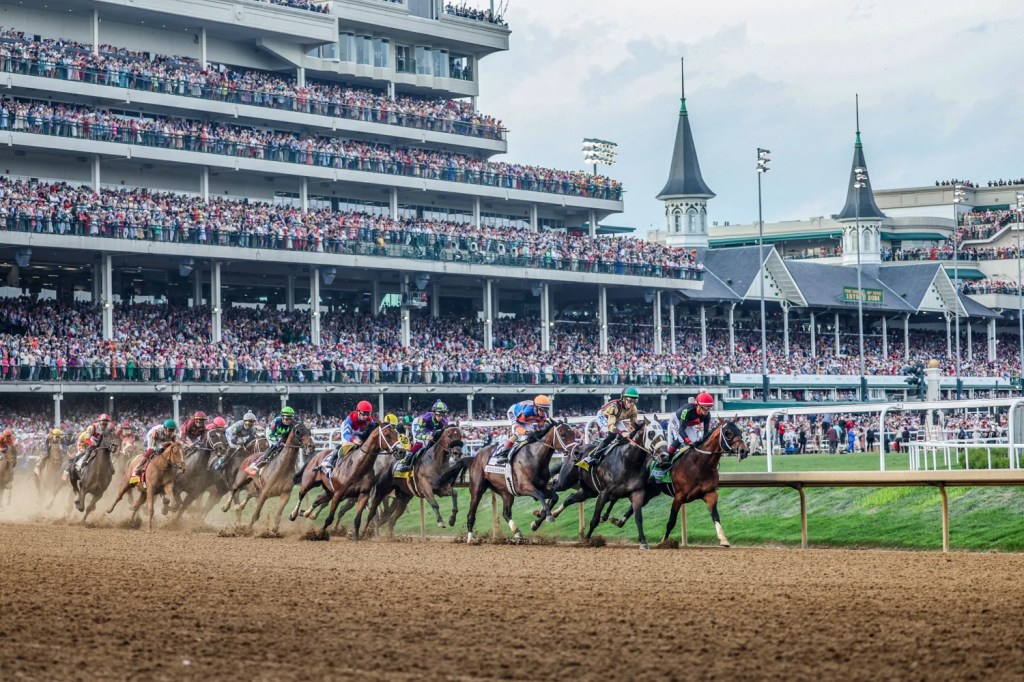
The Kentucky Derby, or fondly known as the Run for the Roses, is the most widely known horse race in the United States, if not the world.
The longest continuously held sports event in the United States is held annually on the first Saturday in May and features more than just the ‘most thrilling two minutes in sports’. It is a cultural hotspot, filled with history and tradition.
But what is the history? And arguably the most important question. How do you get a horse into one of the twenty positions on the track? Well, that’s what I’ll be exploring today.
History of the Derby
The first-ever Kentucky Derby was held in 1875 at what was then known as the Louisville Jockey Club grounds. The Club was organized by Col. Meriwether Lewis Clark Jr., who was the grandson of William Clark (of the Lewis and Clark Expedition).
The 1875 race was a 1.5-mile dirt track (it is now 1.25 miles) and was won by Aristides, who has his own statue at the venue today.
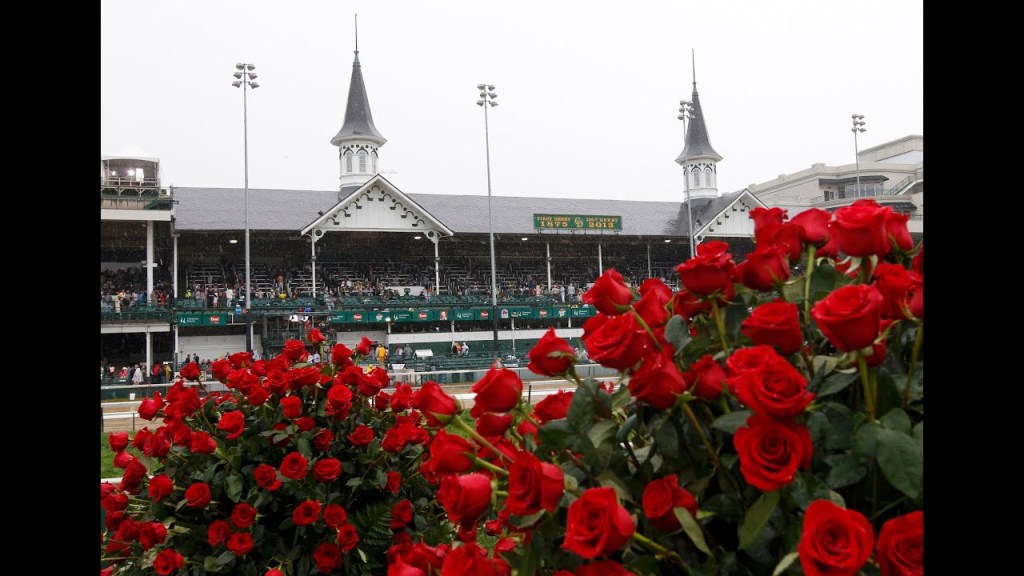
The track was officially renamed in 1937 to Churchill Downs after being named for John and Henry Churchill, who provided the land for the racetrack. The rose also became the official flower for the race in 1901, dubbing it the Race for the Roses.
In the early decades of Churchill Downs, African American jockeys were very influential to the Derby and horses. The horses were often trained, cared for, and exercised by African Americans, especially in the pre-Civil War South, where such activities and jockeying were seen as unsuitable for whites.
Black Jockeys dominated the Kentucky Derby until 1894, when the track upgraded its facilities and incorporated new capital after the Jockey Club ran into financial difficulties when a protracted, gambling-related horseman boycott removed it from the upper echelons of racing. The increased of on-track betting and increasing audience sizes brought larger purse sizes, attracting White jockeys.
With this increase in White jockeys, they began to use violence to attack and intimidate Black jockeys and the horses they rode. This led horse owners to stop hiring Black jockeys, bringing an end to the Black jockey dominance in the Derby.
At the turn of the century, racehorse owners began to run their horses in two other races, including the Kentucky Derby: The Preakness Stakes and the Belmont Stakes. These three races came to be known as the Triple Crown Races, and winning all three would crown the horse as a Triple Crown Champion. Sir Barton was the first horse to accomplish this feat in 1919.
The Derby rose in popularity with its first radio broadcast in 1925 and the first TV broadcast occurring in 1952.
The standing track record for the fastest race run was set in 1973 by Secretariat, at an impressive 1:59.4 minutes.
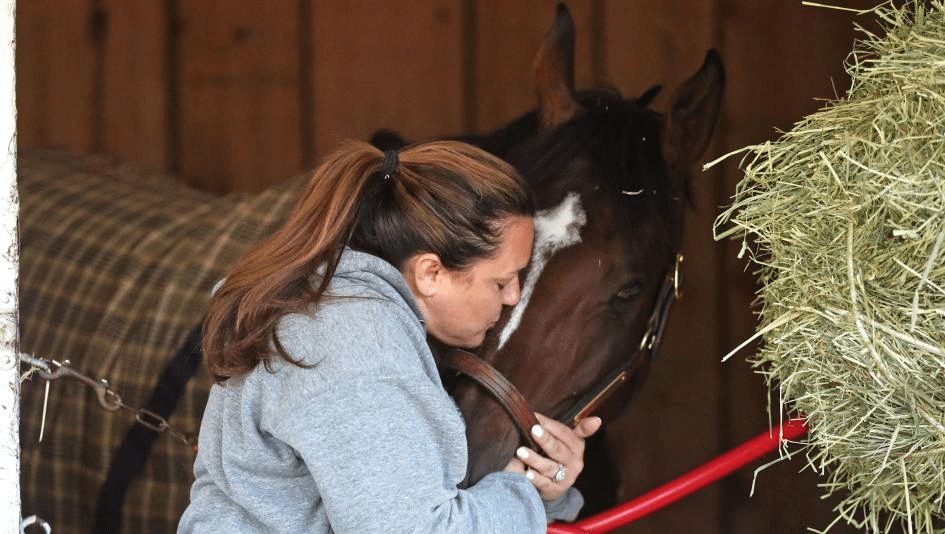
The most recent record was set in 2026, when Cherie DeVaux became the first woman trainer to ever win the Kentucky Derby, as the trainer of Golden Tempo, who came from last place to first at the top of the stretch to win.
Road to the Roses
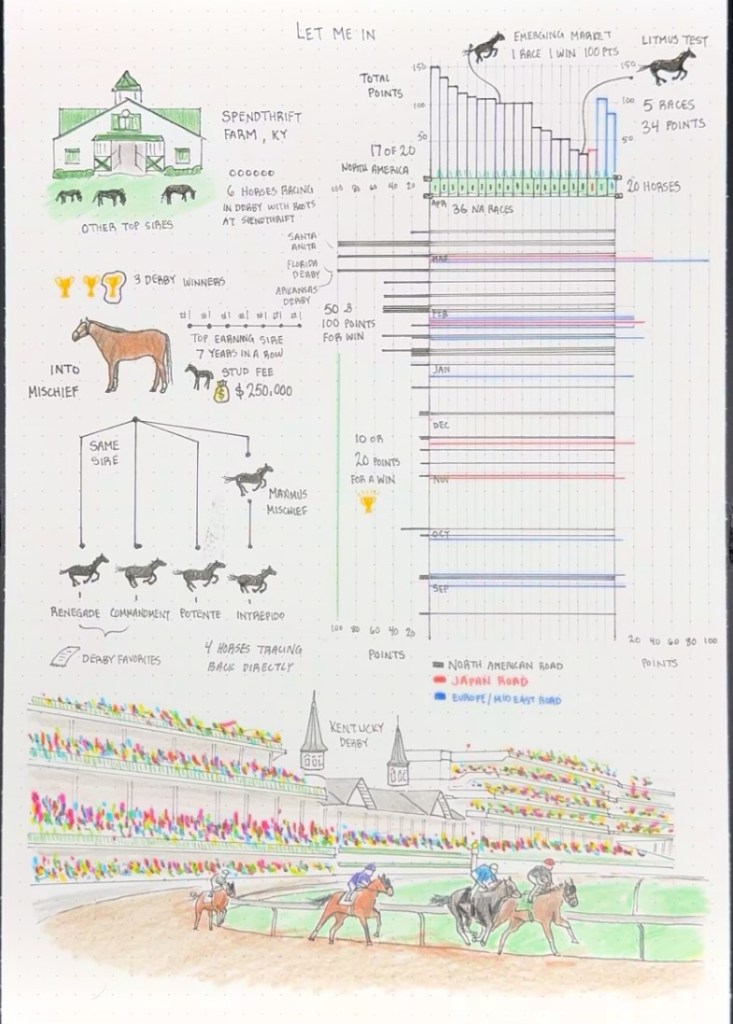
The fight for a spot in the iconic Derby begins in September at Churchill Downs with the Iroquois Stakes, which is the first of the 36 prep races, which are split into two categories: Prep Season and Championship Series. Points are awarded for 1st-2nd-3rd-4th-5th, and at the end of the season, the top 18 horses are selected from the North American road to run in the Kentucky Derby; the remaining two spots are held for the top finishers of the European-Middle East Road and the Japanese Road.
The North American Prep Season includes 20 races. The value of these points is determined by the race and whether it is an initial prep race or a select prep race. For Initial Prep Races, the points awarded are 10-5-3-2-1 points. Select Prep races give 10-8-6-4-2 points; a few examples of these races are the Southwest Stakes and the Holy Bull Stakes. The only outlier to this is the Breeders’ Cup Juvenile
The Champion Ship Series begins with the Risen Star Stakes in New Orleans, LA. The Initial Championship Series races award 50-25-15-10-5 points, while the Select races award 100-50-25-15-10 points. The exception to these values is the Lexington Stakes, which awards the placers 20-10-6-4-2.
The international roads to the derby follow similar rules. Ultimately, the road to the roses is a long and grueling journey, all for the chance to run two minutes for the famed title of champion, as well as the first step of the Triple Crown.
To wrap it all up, the Kentucky Derby is a historical race whose legacy only grows as the years pass, with the 152nd race producing a first for women trainers. Thus, whatever awaits the next 100 years could be extraordinary.


Leave a comment