
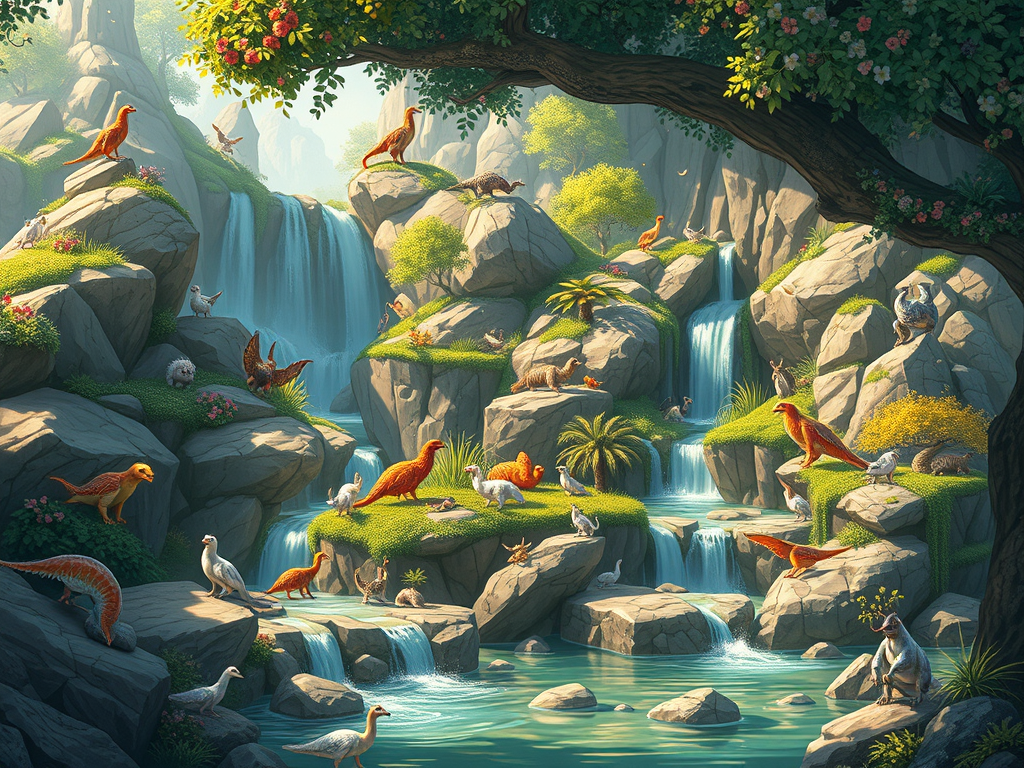
How do you rate an ecosystem? What even is an ecosystem? What makes an ecosystem “healthy”? These are just a few of the questions I should have asked when I started this project. Yet, here I am asking them now. These are questions that I am not qualified to answer for the real world. But, I think I have created a basic system for digital ecosystem rating. While I don’t know if it is the best system it is up to you to debate that in the comments.
The system is broken down into five catagories. You can add or remove catagories as you like. The catagories are creature lore, species interactivity, abiotic factors, species variety, and resilience. Creature lore are the details we are given about a creature in the game. Species interactivity is how complex the interaction between species are. Abiotic factors are the nonliving components in an ecosystem being the ground, rocks, or waterfalls. If it contributes to the ecosystem it is counted. Species variety is the number of different creatures along with different species of one creature. Finally, Resilience is as simple as the ecosystem’s ability to adapt to major outside catastrophes.
The first category of species lore is as stated and details about a creature we are given, whether through gameplay mechanics or through in game data logs. This is gauged overall throughout the game, how well each creature’s backstory is built up. In the case of the game Subnautica the score would be overall higher because of the game’s scanning system.
In this system the player can scan a creature and check the description of the creature in the PDA Databank system. Why is this category important? If you know more about the creature, how it works, how it came to be, or why it looks like it does then the creature is going to feel more alive. While having creature lore is not the make or break for a digital ecosystem if you don’t have any then the ecosystem and the creatures in it are just going to feel shallow and dead. What adds points for this category? Anything that gives the player a better understanding of a specific creature. This really can be anything and that is why the category is not the most impactful on overall score. The second category is species interactivity. This is similar to species lore in the sense that any interaction between species displayed through game mechanics or in game logs. No game does this better than Rain World. While there are no logs or journal entries or anything like that in the games code every creature is programmed to have a reaction to another creature whether that is will eat, neutral, or is scared of. One example is where the King Vulture Creature, one of the biggest and deadliest creatures, has a “wants to eat” interaction for the Chieftain Scavenger, the only “boss” of the game. What makes this so interesting is that these two creatures can’t and won’t ever be able to reach each other the entire time you play the game and still they have an interaction relationship with each other. You may still be asking, why is this category important? To that I ask, have you ever seen a single real ecosystem without creatures interacting either in a mutually beneficial or predatory way? Every ecosystem has creatures interacting in an undefinable number of ways. This leads me onto, what counts for this category? The answer is very similar to the first category, any interaction between species displayed either through game mechanics or logs/ journal entries. These interactions could be as simple as one creature eating another. The only thing that doesn’t count are interactions between the player and a creature, while still technically species on species this is not the point of the interactions nor this project.
The third category is abiotic factors. Abiotic factors are nonliving parts of an ecosystem. This is land the world takes place in, the oceans, the rivers, the soils, the mountains, and the general geography. While there are thousands of games that have great maps, the one that is best for its ecosystem is Breath of the Wild; Tears of the Kingdom. Similar to the first Breath of the Wild, this game contains the main five biomes that divide up the land; however, it also contains The Sky Islands and The Gloom. The Sky Islands are a vast network of floating islands that contain flora and fauna from a period of Hyrule long past. The Gloom on the other hand is a vast tunnel system that extends the entirety of Hyrule also consisting of many creatures thought to be lost to time. While both places typically have one climate they can often be affected by the biome that they are above or below providing space for creatures of all sorts to exist. Why is this category important? Well if you dropped a lion in a tundra it won’t last too long as it is not adapted to that area, or if you have rocks that the player can pick up, like Breath of the Wild, then you can hide insects of all types under them, like Breath of the Wild. This is a category most people think about without even realizing it as it boils down to generally having a good and well thought out map. You might now be wondering how someone defines a good map. The answer in this case is that the better suited the map is for the creatures the higher the rating. So, if you have more places for a prey animal to hide the number goes up, if you don’t have anywhere for the creatures to drink, if the creatures need to drink, the number goes down. It mostly depends on personal opinion mixed with general logic. While this category is important it is mostly already planned for when designing the maps.
The fourth category is species variety. Pretty simple, the more unique animals you have the better. One game that, while it doesn’t have the most flushed out ecosystem, gets species variety write is No Man’s Sky. The reason it is great in this category is because it is procedurally generated for each planet leaving no two planets the same, while some creatures look similar there are still variations that make them unique. Some of the creatures I alone have come across on my journey are weird looking yet incredible beasts, giant rats, robotic dinosaurs, floating jellyfish, and more. Why is this category important? Adding unique creatures to discover and interact with can, like the creatures in No Man’s Sky, make each planet from feeling like a barren wasteland to a thriving ecosystem. What counts for this category? Any unique creature, or species variant. These variants can just be a reskinned creature for a different biome that is bigger or behaves differently from the original. Just something to make the ecosystem feel more alive.
The final and most important category is resilience. This was one term that kept popping up during my research, and for good reason. This is used to gauge how well an ecosystem is doing by how well it reacts to outside factors like temperature, a fire, or other force of mass destruction. There are tons of different games that do this well but my personal favorite is subnautica, because in the game there are really two major things that occur, one is the crash landing of the major spaceship the main character uses and two a super lethal disease that wipes out an entire civilization. These two factors leave some parts of the ecosystem untouched and other parts completely destroyed. For example, the place the ship crashed is reduced completely to sand and the radiation seeps out into nearby biomes. Even with all this the ecosystem seems alive and well. The virus on the other hand, can be found on multiple creatures all around the map. Yet the ecosystem is still going. Why is category important? An ecosystem’s resilience is really the only way to tell how well it’s doing, so while you don’t have to throw a meteor at your planet or any other large scale disaster, do remember the impact your actions will have on the space around you. Now comes the question of what counts for this category? This is category most up to interpretation as if the game or other digital ecosystem you are rating doesn’t have a major or minor crisis going on it is hard to say one way or the other, so the best way to handle this is to see the ecosystems reaction to the major conflict of the game or the players actions.
This system is not perfect. It is not full proof or the “right” way to go about it. This is designed to be used as a model that you can use if you don’t have the time or effort to make your own or for you to shape into something for your unique scenario. Though there are only 5 categories it should provide a pretty good judge on the ecosystem you are looking into. The best thing you can do is keep researching, keep looking deeper, and keep questioning your conclusion.


Leave a comment