
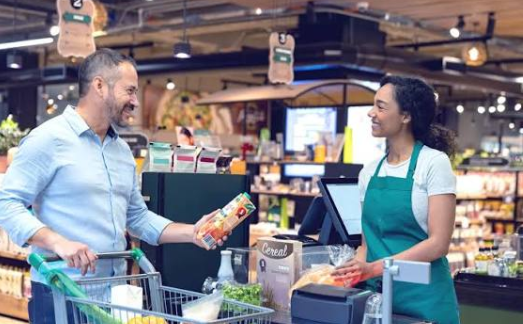
Grocery stores are simple. People enter, get whatever they came to get, checkout, and leave. However, when customers start to pay for themselves then the experience is changed. While normal checkout lanes and self checkout stations functionally serve the same purpose, they completely change the mood and mindset of shoppers. While normal checkout lanes feature a traditional cashier, conveyor belt, and interaction with customers to promote human interaction, self checkout stations use scanners and instructions to encourage shopper’s independence.
In normal checkout lanes, the first thing you notice is the layout. The labor is split between the customer and the cashier. The customer is on one end loading the groceries onto the conveyor belt while the cashier stands at the other end scanning and bagging the items. Two people, two jobs. Then, the cashier completes the transaction while a separate employee usually loads the bags into the cart while the customer patiently waits. Simple, easy, and reliable. After this, the cashier and customer may even have a brief conversation.
The self checkout process feels much differently than the normal checkout process does. Instead of a human interaction and labor shared between them, the customer scans, bags, and pays for their groceries all on their own. Scan the item, bag it, rinse and repeat. Simple. The instructions and screens eventually lead the customer to paying instead of a cashier doing it for them. These steps virtually are all done by the customer. Without a cashier then there is no more human interaction, which makes it more efficient too.
The difference seems small, but in hindsight it completely separates the two experiences. At a normal register, the customer is just a plain old customer. At the self checkout machine, the customer is the customer and the cashier. In my own experience, I see the lines for traditional checkout lanes much slower and longer than the ones in the self checkout lanes. The people seem more agitated and ready to go. This is extremely important because it changes the entire experience.
But that’s the interesting part. The self checkout seems to be more convenient and faster because the customer can have more control over everything that’s going on. However, some customers may not want to do it all themselves and it introduces a problem: it transfers the work from the employee over to the customer.
The difference between these two ultimately reveals something about our lives too. We grade and experience based on how efficiently and quickly it happens. However, while efficiency is good and all, we lose the human relations aspect. The self checkout lane doesn’t only change how we pay and bag our groceries, but also what the store expects us to take it upon ourselves to do.


Leave a comment