
In many elementary, middle school, and high school classrooms, each new year is kicked off with what they call a “social contract.”The definition, according to Britannica, is an agreement that defines the rights and duties of those who rule and the ones being ruled. An unwritten agreement where people give up some freedom in exchange for safety, order and protection of rights.
All to say that it reminded me of our relationship with control. It is in the biological and innate instinct of people to have the desire for control but a lot of times things go beyond the way we want or the way we planned.
A lot of times, the illusion of control blinds us to see how much the environment shapes us rather than the other way around.
Our space, our environment shapes us constantly, even if we don’t notice. Paying just extra time to study the space around us can tell us a lot. Like, what the creators of the space really value, how a space accidentally undermines its own purpose, or how a space might attempt to rewrite who the user is.
The space of a place also dictates the environment and the way people move, act and feel things. Two different spaces with the same purpose can also reveal aspects about society, community and human nature through its different designs.
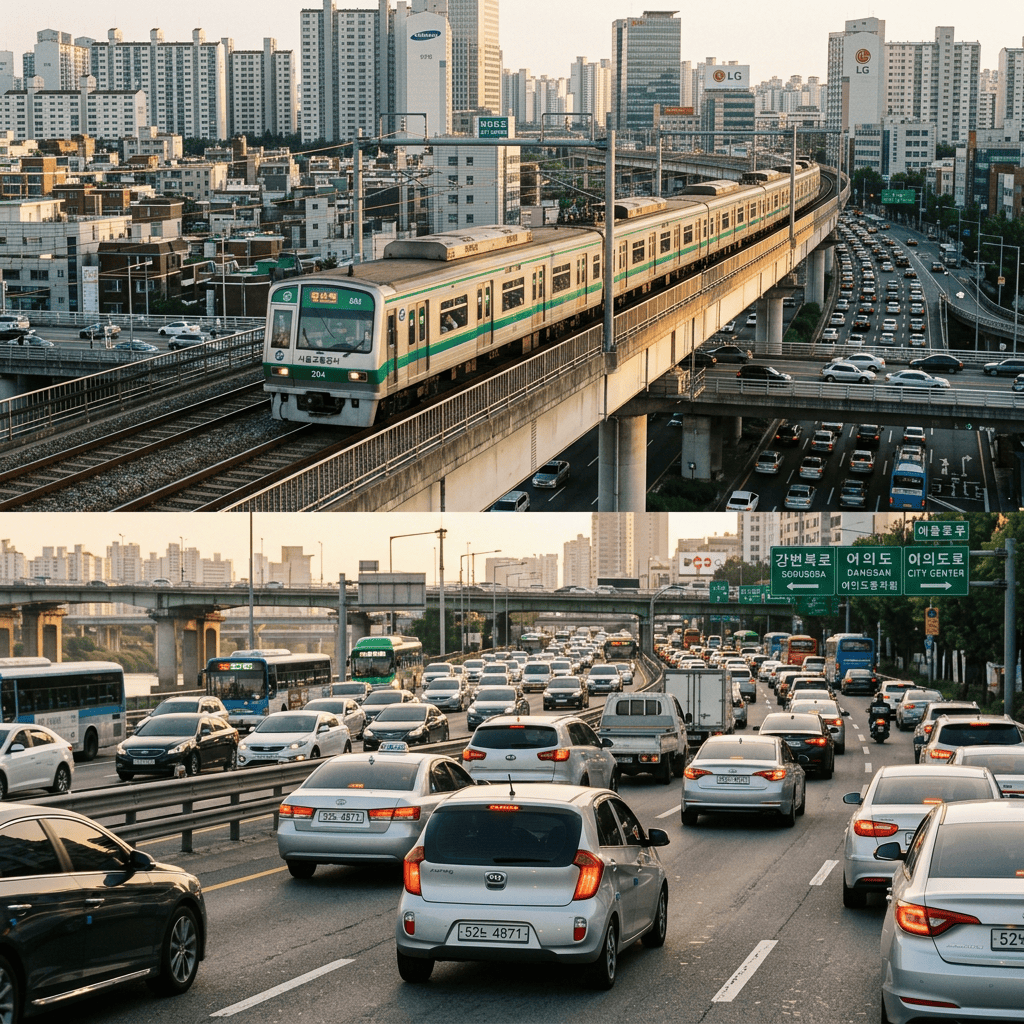
Subway trains and cars. While both subways and cars exist to transport people from one place to another, subways rely on its capacity to hold masses of people to encourage movement and efficiency, while cars use its design of being physically isolated from other drivers to enforce focus and order.
Control. The difference between driving a car and being a passenger to a subway is one, being a driver and passenger, and two, what we’re in control of and three, the way the space makes us act and feel.
Korean subway: an electric rapid transit system that provides fast public transportation across major South Korean urban hubs.
I live in the U.S Georgia but I was able to go visit Korea for a month in the summer. One of the most drastic differences from South Korea and America was its reliance on cars. In the U.S it’s difficult to go anywhere without a car, and many teenagers earn their license as soon as they come of age, however, in Korea many do not even own a car, instead, almost everyone travels and commutes via subways and buses. Subways are now such a common method of transportation that it goes unnoticed how much the space has on society and individuals on how they might move and act.
Subways may be divided by cars and the plastic seats are lined up against the walls of the subway, all connected to one another in a way that everyone would be almost shoulder to shoulder with the person sitting next to us. It might give the sense of community and connection, but when we sit there staring at our phone, it makes our own bubbles and we feel isolated from everything around us. We feel in control of our own bubble and our actions, however, that’s when the space subtlety influences us.
In a subway, we control what we do at that time. Sleep, listen to music, social media, call, text etc. We control which station we get off at and where we might choose to sit. We cannot control, however, which way the subway goes, how fast, how it gets there and when.There’s also a sense of urgency when a line of people start cramming and filing into the train at a stop. The sliding glass doors open and people instantly leave or come in. If it’s full, people might cram shoulder to shoulder and stand holding the railing or the handles. If not, people sit between the seats, leaving a couple seats empty between them and their neighbor.
Being an extrovert and a naturally chatty person in a Korean subway can feel quite suffocating. That’s how I felt being in a subway at least.
No one makes eye contact.
One time, on my way to Busan with my family, sitting there sort of feeling awkward and subconscious (though no one was looking at me), someone sneezed. By instinct, I whispered to the man, “Bless you.”
Instant side eye. And yet, still no eye contact.
The space feels tight enough that it’s easy to look over and see what the person next to us is doing on their phones, or hear the slightly muffled music seeping through their headphones, but still long and wide enough that it makes us feel small and almost not there. Isolated.
Cars: Motor vehicles used for driving.
I earned my learner’s permit recently. Driving is drastically being a passenger and riding around in a golf cart. As a passenger, like the subway, we get to decide what we do during the ride but we can’t control the direction the car is going, how, or when. But being the driver, we give up the freedom to do other things other than drive during the ride. The space determines that, giving multiple things to focus on and also determines how it controls and limits the way you move within the freedom.
Cars usually seat 2-8 people, ranging from small cars to minivans. The driver’s (in America) seat is in the front left and can see the road clearly. From there, there are review mirrors that show either side of the car, one to see the back and the sides. On roads there may be multitudes or even no cars surrounding you and they all seem to have a sense of purpose and an invisible line they’re following. Being physically isolated from other drivers may give you a sense of privacy, but at the same time, drivers are connected together through a big web of movement that influences each driver.
Each space gives certain freedoms to the people using it and also quietly controls the way we actually use or move in that space. We may not realize the factors controlling and influencing us at the moment, but the space, interactions of with other users, and unspoken rules always dictate us in some way or other. Like how being a passenger in a subway draws an isolating bubble around us despite the physical closeness, or the connection driving a car makes us feel.
A lot of times, the illusion of control blinds us to see how much the environment shapes us rather than the other way around.


Leave a comment