
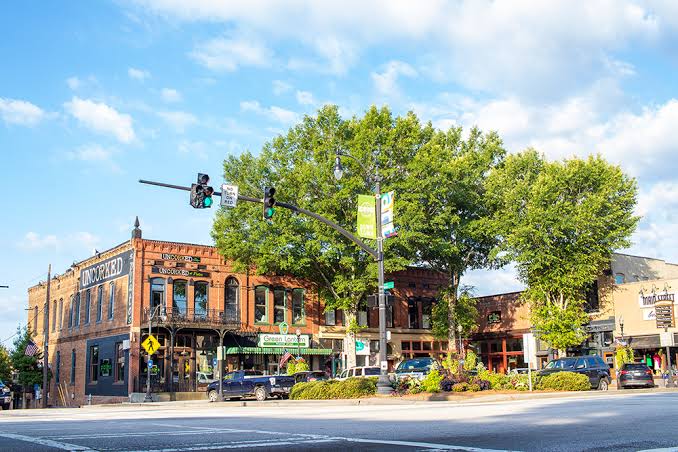
At 45 miles per hour behind the steering wheel, a town is just a blur of gas stations, fast food, and asphalt. But slow down to a speed of three miles per hour on a walk, and the intentions of a space suddenly come into focus.
For most of my life, I expected car-centric sprawl to be the layout of modern existence. An artificial landscape designed for maximum speed and convenience. Testing James Howard Kunstler’s critique of suburban sprawl on foot during our walking tour of Adamson Square proved that when we design spaces for humans rather than automobiles, we can cultivate an authentic public realm that fosters the civic interactions that modern sprawl strips away.
In his TED Talk, “The Ghastly Tragedy of the Suburbs,” Kunstler argues that modern suburbs are full of “places that are not worth caring about,” because they destroy the civic realm. He explains that an authentic public space needs boundaries; buildings should frame the street like an “outdoor room” to make pedestrians feel welcome and safe. In typical suburban neighborhoods and strip malls, that feeling is ruined by massive seas of parking lots and plain, throwaway buildings that are set far away from the road. Walking through Adamson Square was a real-world test of Kunstler’s theory. On our walk there, crossing the highway left is completely exposed to the multi-lane, rushing traffic. But once we entered the square, the energy shifted immediately. The historic brick buildings sit right up against wide sidewalks, with shop windows at eye level. Short blocks make the downtown area easy to walk. Rather than dodging cars, you’re surrounded by storefronts, trees, and benches. The design sends a clear message: people are meant to be here.
Kunstler also points out that suburban design isolates people in private bubbles. Trapping us in our cars between our homes and stores. Walking around the square shows how human-scaled design brings back spontaneous social encounters that make a town feel alive. The outdoor tables at Brown Dog Eatery and Local Ties Brewery allow people to sit and chat without feeling forced to buy anything or be rushed along. Inside Gallery Row, cozy couches and tall tables encourage people to stay a while instead of rushing out like at a drive-thru Starbucks. Chatting with a few people who frequent the square confirmed this dynamic. Several noted that the physical layout naturally makes them want to linger and talk with neighbors, transforming routine errands into meaningful social interactions.
This dynamic reminded me of Jane Jacobs and her ideas about “eyes on the street” and the “sidewalk ballet” in The Death and Life of Great American Cities (35). Jacobs argued that walkable streets build community trust through everyday interactions. In Adamson Square, slow traffic allows pedestrians to move comfortably. While shopkeepers and diners naturally keep watch over the streets. This fosters the social interactions that we have lost through modern suburbanization.
However, street layout and architectural framing are part of how inviting a place feels. In larger cities or areas with high crime rates, human-scaled design alone may not guarantee comfort. Concerns over personal safety can make pedestrians feel uneasy, turning an otherwise walkable street into a space people avoid. Furthermore, there is often a gap between actual crime rates and the perception of safety. Walking on foot can feel inherently vulnerable compared to being inside a vehicle. A public space must not only keep crime low, but also feel safe through bright lighting, active foot traffic, and clean surroundings. Yet in places like Adamson Square, where human-scaled design is reinforced by low crime rates and active community visibility, the physical layout successfully supports both social connection and personal safety.
Using Kunstler’s ideas as a lens during our walk around the square completely changed my perspective on how our environment shapes us. We often mistake driving speed for freedom and for getting places quickly, and parking spots for convenience. However, trading away the public realm leaves us feeling isolated in places we don’t care about. Adamson Square proves that when a town prioritizes people over cars, it can build something truly worth caring about.


Leave a Reply