
You are constantly viewing the world around you through a very small, very distorted lens.
It’s not a negative thing, per se, but it’s just the truth. Taking a walk through the forest, you look at the canopies and leaves, and perhaps not the concrete on the ground. In a coffee shop you might look at someone differently depending on what side of the counter they’re on. Depending on your environment, there are certain aspects of the world you might notice, and certain aspects you might not see at all.
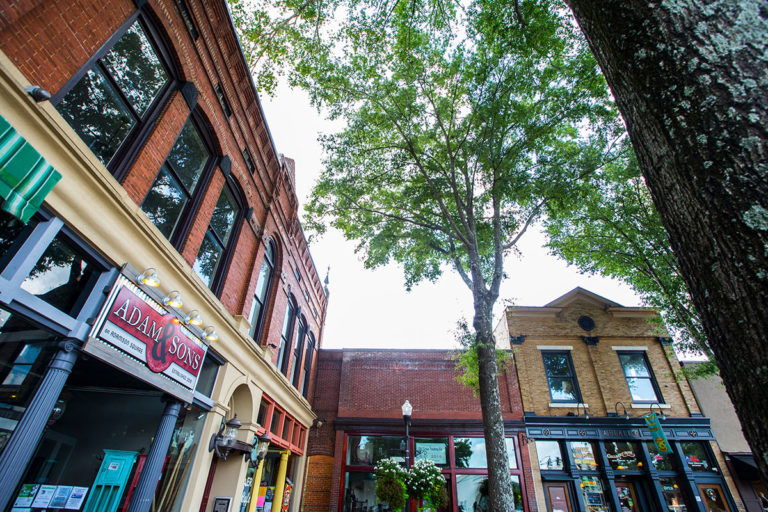
In October of 2026, I took a walking tour through Carrollton’s Adamson Square with my high school Language class, with the intention of observing suburban spaces and the effect those spaces had on the community around them.
To be frank with you, I don;t think I was as focused on the learning part of it as I was on simply the experience, and the donuts and boba I bought during my stay. (Shoutout Sprinkles Donuts and Coffee, I’ll never be the same).
Nevertheless, throughout this walking tour, I noticed a number of things, and noticed not noticing a number of things. The plants on each corner of the square, the coffee shop I had never seen or been to, the giant textile museum larger than anything else in the area and yet unnoticed by me till someone pointed it out.
It sounds backwards, but hear me out.
I have driven through Adamson Square a number of times, often only passing through en route to a different location. The stores and restaurants were a blur of colors, the background between here and there.
During this academically glorified stroll of the downtown area, however, you could look at the entire city block differently. Going through instead of going past, you could notice the details around you, the signage, the community, the life that prospered in the square, the beauty that blossomed in each establishment.
Even in my aforementioned trip to Sprinkles, seller of ambrosia and nectar, food and drink of deities, I could see the establishment in a whole different light;
This restaurant was placed in such a manner, some 200 feet behind the next stoplight and 50 feet from the nearest curve, that driving past it I would only notice it as a blue and pink sign blurred across an arc out my window as my car drove somewhere further away. Right there, details visible and apparent and yet unnoticed by me till now that I stopped to look deeper.
From the very same spot in the middle of the road, looking at the exact same things, only in something less of a rush, you could see so much more in the same things you previously saw nothing in but a blur of color.
I then began to wonder how often in one’s day to day one may be going past instead of going through. How often are you so entrenched in your goal that you forget the journey?
I’m certain the fruition of the car and some other technologies in our day to day life has increased this phenomenon, though not necessarily the root of it. In Rebecca Solnit’s Wanderlust, Solnit provides some commentary on this concept regarding the epoch of the car and the propagation of technology in replacement of many other forms of media and learning which required a longer journey, a path to take, a length to travel, an effort to make, with a scenery and space to appreciate in between.
“Stepping from path to road means stepping up to see the whole expanse of the ocean, spreading uninterrupted to Japan. The same shock of pleasure comes every time I cross this boundary to discover the ocean again…”
Solnit makes it clear how, in her day and age, before the avenue of technology making such travel “obsolete” in the eyes of people desperate for efficiency above all else, the journey from place to place, start to finish, there was life in between.
In a later paragraph of Wanderlust, Solnit describes how the growing sparsity of travel in populations around her has caused said population to become fearful of roads and paths that were once walked so often. The unfamiliar is seen as dangerous, that which is outside of one’s own familiarity is feared. Children are told to stay home, confined to just one space, just one lens from which they grow to view the world. A lens which only shows point A and point B, and disregards that which is in between.
The paths you walk every day, or paths you don’t walk, affect your psyche and view of the world in this manner. The spaces you are in and the spaces you are not in.
Back to the case of the Adamson Square; the hustle and bustle of this city block is seen as a blur of motion to one driving past and a whole world of life to one moving through.
Similarly, in other even less familiar locations, the same may be true, in a way you may have not noticed.
When you are driving through the roads to your local Chick-fil-A or school or a friend’s home you may not notice the streets you drive by, desolate of the walkers and wanderers Solnit spoke of in such high regard, but nevertheless a space filled with people and their lives, scenery, infrastructure, stories, be it in the gallows or suburbs or slums or cities. These spaces and experiences hidden in your peripheral, or subconsciously feared due to their unfamiliarity, are viewed in such ways because of the space through which we, the modern citizens, locked up in our houses and cars, have learned to experience the world.
Often, here in our day and age, as people have become so used simply making it to their destination, to speaking to a coffee clerk like a disembodied hand instead of a person, to driving past the lush and feral life in your community, to only viewing the world through a lens forged from a lifetime of disregarding spaces and people and experiences seen as unimportant, forged from lifetimes of ingenuity ardent for efficiency that seems to not matter as much as it did in those lifetimes, in this lifetime, in this moment.
From the spaces we live and breathe in and move through, we learn to see the world a different way. Perhaps in a diminutive way. So I implore you, dear reader, to take a closer look at the places you pass through, and the life within them, and perhaps you will find that the lens through which you have learned to view the world, rushing through life with a goal always in mind, efficiency always in mind, does not show you everything there is to love.


Leave a Reply