
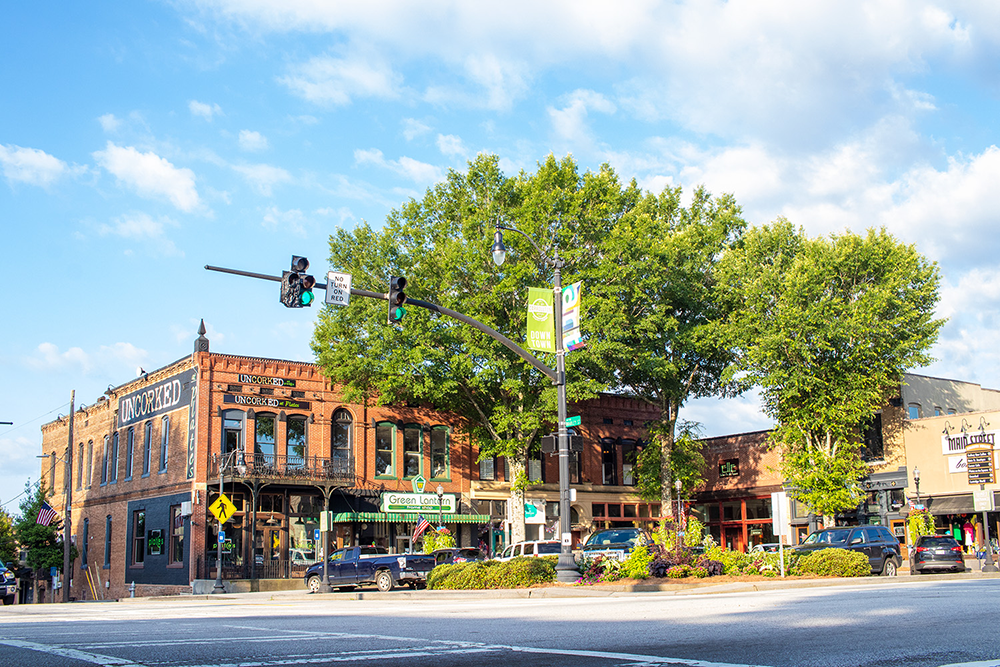
Jane Jacobs, renowned historian and author of “The Life and Death of Great American Cities,” openly perceives the suburbs as an entity which has transformed the laws of nature as a result of society’s tendency to categorize metropolitan areas into a part of nature. This unspoken change has become so prominent in our growing society that even in Carrollton, Georgia, we have allowed for this town to succumb to the conventionality of suburbia while also creating an inviting environment that promotes the small-town experience.
SUBURBIA AS WE KNOW IT
As a way to see how suburbia has filtered into our hometown, we took a walking tour through Adamson Square in which we evaluated and rediscovered the construct of the area based on our research of suburbia. Having been to the square more times than I can count, I never thought of this small town to be anything more than a place where I live, where I have met all my friends and experienced my entire childhood. Through this experiment, I was able to understand how suburban life has impacted the world around me, even in the most subtle ways.
From the small, stout commercial buildings in the middle of the square, to the comparatively gargantuan city hall, suburbia is everywhere in Carrollton. The infrastructure of the square impacts the entire ambience of the community; the boxy city hall and courthouse give the outskirts of the square a more official, white-collar feeling; whilst the quaint, older buildings provide a friendly and nostalgic welcome to newcomers or residents of this town, inherently persuading consumerism.
The square is not only used as a commercial endeavor, but also an accessible roadway through the town. Adamson Square marks the middle of Carrollton, providing an easy way to get to anywhere within the town. In order to cater to both drivers and pedestrians, crosswalks allow for safe walkability without severely disrupting the flow of traffic, promoting movement in both vehicles and humans. According to Rebecca Solnit, this “on foot” experience allows for walking and driving around town to “stay connected.” This coexistence of humans and technology within the crosswalks and roadways of the square create a sense of security in pedestrians while acting as a convenience to drivers.
THE CONCRETE JUNGLE
As previously stated, Jacobs uses our growing society to capture how “we and our cities, just by virtue of being, are a legitimate part of nature too,” creating this essence of true suburbia that she depicts which can be translated into our downtown culture. In an effort to invite the natural world into the atmosphere of the square, parks are incorporated into the surroundings, serving the ability to portray nature within the outskirts of an infrastructural based downtown area, giving the square a more “natural” feeling as opposed to a strictly concrete jungle. The experience of suburbia in Carrollton is ignited by this relationship between humans, nature, and technology, serving as a reminder that we, as a community and a town, are still an important part of nature.
THE DOWNTOWN SUBURBS VS. THE TRUE SUBURBS OF CARROLLTON
While the square has the ability to compel residents and visitors to enjoy the presence of Carrollton, that same charm does not exist everywhere within the town. Adamson Square is known as the hub of socialization within the community. As a lifelong resident of Carrollton, I have been able to indulge in all the stores, restaurants, and recreational activities it holds. Visiting the square has become a tradition within my friend group. Going out to dinner, exploring the Vinyl Frontier record store, or getting a coffee at Gallery Row are experiences that I have cultivated with a multitude of people. The square gives us an opportunity to enjoy each other’s company while being in a comfortable, familiar atmosphere.
The numerous stores, coffee shops, small parks, and restaurants in Adamson Square provide a way to get the most out of what Carrollton offers, but if you drive around the town enough, you will see how we also harbor the suburban tendency to replace small-town culture with big-box corporations and overflowing strip malls filled to the brim with people. Not only do these strip malls contain the same stores, products, and infrastructure all around the country, but they disregard the natural attributes of suburbia, attributes that the square has perfected.
Although, yes, the square does have its own version of intended nature through the meticulously placed trees sitting in front of commercial businesses, it also has a good urban design. The surroundings of this area are much more connected to the natural world by providing areas like Alice Park and recreational activities, such as the Carrollton Presbyterian Church playground that is surrounded by greenery and naturally placed trees, and large oak trees spread across the downtown area, providing shade and comfort to anyone enjoying time outside.
Unlike the square, strip malls contain little to no natural presence (save for the trees intricately planted on the median dividing the parking lot spaces), connotating a mundane, uninviting, conventional suburban experience, affecting its overall environment. This sterile coolness of strip-malls directly affects how the customer interacts with this environment. Living in a town that harbors both the quirks of a downtown area and the blandness of shopping centers, I much prefer going on excursions to the square because its atmosphere is more pleasant; I can cultivate memories with friends and family in a place that allows me to fully enjoy its presence. Large corporations jammed together to promote consumerism actually drives me away.
After we took the walking tour, my mom and I went to Publix to get groceries. It was then that I realized how distinctly different the Publix strip-mall was compared to Adamson Square.
There is no individualism within these strip malls.
I have been to multiple Targets all across the country; none of them are any different than the other. This mundane invasion of strip malls through the lack of nature and personality foster ill-enjoyment for the consumers of these establishments.
I find that what we identified as the suburban attributes of Carrollton’s Adamson Square are infinitely different from those of the ubiquitous strip-malls strewn across every county. This duality between the environments of both places reiterates how suburbia in Carrollton has been implemented through both the natural rooms of the square and the (un)natural band-aids of shopping centers.
IN RECAPITULATION
Humans inhabit this earth.
Inherently we are in charge of it through our actions, recreation, ideas, interests; our own lives directly affect the planet as a whole. The influx of suburbia has influenced our place in society. Suburbia has changed the entire meaning of the world.
Suburbia is everywhere.
But, why is this? Why do I believe this? How did I come to this realization? The answers to these questions lie within the seemingly irrelevant town we call home.


Leave a Reply