
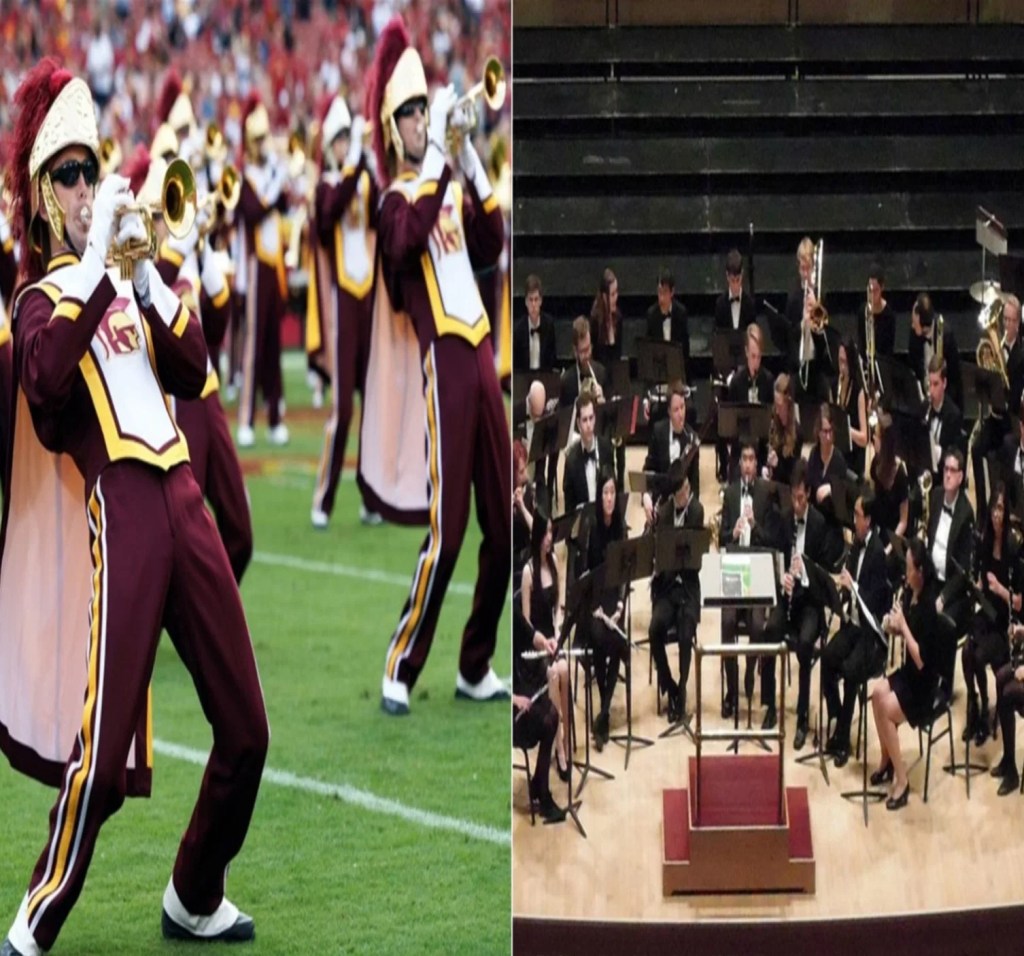
When people hear the word “band,” they might picture musicians sitting in chairs, reading music, and performing on a stage. But the band can look completely different depending on the season. Two of the biggest parts of band are marching band and concert band. While both involve playing an instrument and working together as an ensemble, they have very different experiences.
Ask any high school band student about their fondest memory, and they won’t tell you about the quiet precision of sitting in a chair during the school day in concert band, They’ll tell you about Friday night lights, cold stadium bleaches, uniform plumes, and the thunderous roar of the crowd. Having survived both grueling July band camps and quiet concert band rehearsals–and even taking home championship rings while fireworks went off at the Ring of Fire competition–I’ve lived on both sides of the coin. Yet, ask that same musician which experience fundamentally changed how they listen to and perform music, and the answer flips instantly.
While both marching band and concert band aim to build musical excellence, marching band prioritizes high-energy visuals, group coordination, and crowd-pleasing showmanship–proving that memorable experiences rely on shared adrenaline and public tradition. Concert band, however, prioritizes acoustic blending and deep artistic precision–proving that long–term musical impact stems from quiet mastery, internal discipline, and subtle expression.
Marching band is designed to deliver epic, high-stakes stakes stadium performances, yet its rigid drills and repetition often end up forging deep, lifelong friendships off the field through shared struggle. Contrarily, concert band is designed for refined, highly technical ensemble playing, but its seated, individualized focus can accidentally create a quieter, isolated environment where members connect primarily through the music rather than social interaction.
Marching band treats the performer as a united entertainer who shows school pride and thrives under intense pressure, whereas concert band treats the performer as a precise musician-artist who connects deeply with complex compositions and personal passion. Ultimately revealing that marching band crafts unforgettable memories through shared culture, while concert band shapes deeper artistic growth. At the end of the day, matching marching band against concert band isn’t about deciding which one is superior–it’s about recognizing how they shape us in entirely different ways. One builds the memories you’ll talk about at reunions for decades; the other builds the musician you’ll remain for the rest of your life.


Leave a comment