
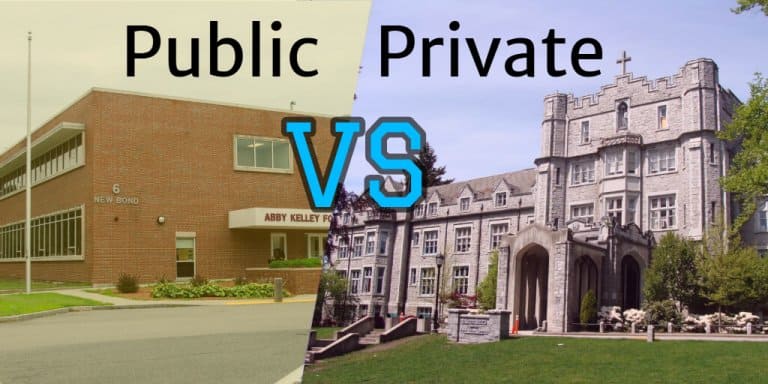
While both private and public schools exist to educate students, they differentiate in their values. Private schools rely heavily on smaller and targeted teaching to encourage participation and comfort, whereas public schools use broad and consistent rules to enforce equality and govern structured education to all–ultimately revealing that the environment and design of a school impacts the process by which students learn and socialize.
Private, as well as public schools, both communicate their values through their designs. Public schools rely on a large population, substantial classrooms, diverse pathways, and athletic devotion. They communicate a sense for diversity without overemphasizing any student’s education over another. Private schools, on the other hand, strictly are intended for smaller classrooms with a low teacher-student ratio and limited enrollment in order to empower students into a comfortable and personal environment. This underscores the idea that a school’s environment and social design heavily reflects matter into its educational system.
Private schools are intended to provide specialized, personal education, as they prioritize providing an optimal learning environment because of pressure to justify the cost. The values put into this features engagement, belonging, and sense of comfort. Acknowledging this, students may perceive private schools as superior to public schools and more attentive. On the other hand, public schools provide standardized education to a bigger population, where they are forced to prioritize equitable education to the accessible or inaccessible, financially advanced or struggling, and even academically advanced or uneducated. This contradicts the values that private schools display by ultimately revealing that the values from both schools fairly is dependent on social system and environment.
The configuration of private schools treats students as a representation for certain religious beliefs and as academically driven individuals. On the contrary, public schools perceive their enrollment as individuals who may be intrigued by numerous extracurricular interests and diverse career aspirations. As documented before, students every now and then will attend a certain public school, exclusively for the desire to play on a certain team sport that they offer. This supports the idea that students may be attracted to the extracurricular aspects of a school, which is the sole reason why they may prefer to attend a public school.
Although both schools contain students who can be highly focused on their studies, private schools are more likely to obtain a greater proportion of students who are academically disciplined. One of the main distinctions between the two is that public schools allow students to achieve their academic goal for free, rather than paying tuition.
Although they have distinct environments, they collectively serve the same purpose of educating students and preparing them for the future. The designs of private schools, featuring paid tuition, personalized teaching, and limited enrollment, altogether, encourages students that are academically disciplined and goal oriented. In comparison, the designs of public schools such as, exclusive opportunities, varied academic pathways, and inclusive accessibility, all collectively provide all students with the opportunity to achieve any dream they pursue. Ultimately, these different designs demonstrate how students get educated, which overall shapes their identity.


Leave a comment