
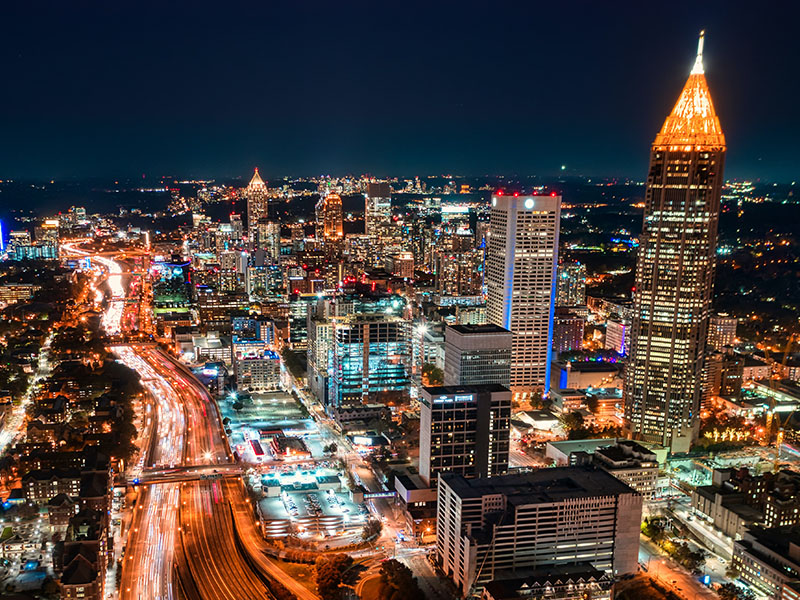
Atlanta: the City of Trees, Southern Hollywood, or the City Too Busy to Hate. Atlanta is one of the biggest cities in the southern United States; a hub of urban activity, business, pleasure, and travel. Though to the natives of ATL and the surrounding cities/counties Atlanta better aligns with the ideas of James Kunstler who believes urban spaces to wastes of space and resources. So in the words of Kunstler the residents of the areas surrounding Metro Atlanta would likely describe it as a “ technosis externality clusterfuck”(Kunstler). The majority of GA natives despise going into ATL because of the Gordian knot highways and bridges that surround the busy city space . The traffic, the airport, and the insane drivers make Atlanta a particularly distasteful city.
But perhaps it’s the towering skyscrapers, cracked sidewalks, and 80s sitcom matching houses that mean more to us than we believe. Many of us will live our entire lives surrounded by cities or working in them. We will meet people, love people, and indulge in these concrete jungles. So maybe, just maybe, the asphalt and cement that surround us hold our greatest memories and cultures.
Your average suburban neighborhood consists of cookie-cutter houses with the same perfectly manicured lawns. The stereotypical American families inhabit each one. But some of my greatest memories are housed in the very sidewalks of neighborhoods like these. I remember being a child during summer break and spending 6 hours outside, running around my terrible rental neighborhood in Kansas City. The houses were put together with cardboard, but 8-year-old me didn’t care.
I ran wild with my neighbors; we played in inflatable pools, and once we spent an entire day catching frogs out of the “pond”. Which in reality was a ditch created by cars running over excess cement; that subsequently filled with stagnant rain water. As the summer trudged on the once cleanish pond turned to a cesspool of green brown waste. But even though the water was likely parasite ridden we would spend hours around this pond and the concrete dunes the other mounds of poured cement created. The neighborhood was a large expanse of nothingness, but to me and my friends it was the most important dead urban area ever. I don’t think I would trade a little house in the countryside for the millions of memories I made in those 3 summers. From catching frogs, to riding our bikes to the top of hil just to race down afterward. The simplicity and deadness of the area just made us that much more creative.
But Urban spaces mean more than just summer fun with neighbors. Cement monuments also hold deep cultural significance. The steps of those who walked the streets before us are what truly shape the skyscrapers that currently stand above them. The mix of old and new infrastructure in an urban space is what keeps cities alive or, to quote Anna Kode in U is for Urbanism: “If a neighborhood only has new buildings, the cost drives out diversity”. The historical and pop culture of cities is what keeps us coming back in spite of the traffic. Like the City of Trees Atlanta has so much history and culture under the layer of urban sprawl. Atlanta was the birthplace of Dr. Martin Luther King Jr., and was the area in which the 1906 Race Massacre occurred. It also a hub of music: Rap, R&B, and Jazz to name a few
So, I disagree with Kunstler, I think that drab urban spaces are only “drab” if you make them. It only takes a bit of imagination and movement to transform a flat millennial grey space into the wildest memories of your life.
We come to Atlanta for things like music festivals, theater, food, and games. Atlanta has become famous for its Black history and the importance of civil rights; it also houses one of the best aquariums in the world. The Olympic Centennial Parks, and the museum of Coca Cola. All of these places, people, and history are Atlanta, the infuriatingly busy city, but it holds some of the best memories and culture this world has to offer.


Leave a Reply