
The sound of the teacher’s short but understated explanation of the most recent reading activity that he’s assigned since the beginning of class would automatically send me into a spiral of weariness and desperation for the day to end in the blink of an eye. The worst part? We have to analyze every paragraph and search for answers lying beneath a jungle of words I never thought I’d see throughout the semester.
That was until now, or only a few weeks ago, when the writings that I expected to be monotonous had surprisingly revealed my surroundings and how they’ve changed for the better or worse in modern society, with the opinions of different authors reaching my train of thought that were concealed from my grasp as their main audience. As a result, these new ideas and perspectives on how our world is progressively changing revolve in my mind in an endless loop, questioning the sights I see when I take the time to gaze at the environment around me as I pass by, and connecting right back to one question that I find built around the materials that I’ve read throughout the weeks until now: Are Urban designs making way for new developments, and how can that be seen going on through the opinions of different authors?
After taking a look at the course materials provided to me by my professor- shout-outs to him- I can conclude that while urban areas continue to develop and build for the future of our society, the views of other spaces deemed unnecessary for the contribution of urban areas are soon seen as a huge stone that should be removed and replaced with other structures considered as “treasure” to grow at a tremendous rate.
An example of something similar to my argument can be seen in an article titled “The Death and the Life of America,” where author Jane Jacobs addresses the destruction of rural landscapes, observing that “It is no accident that we as Americans, probably the world’s champion sentimentalizers about nature, are at the same time probably the world’s most voracious and disrespectful destroyers of wild and rural countryside”. While popular opinions suggest that rural spaces are meant to be ruined and taken for granted for the development of cities, Jacobs refutes this, saying “Nature, sentimentalized and considered as the antithesis of cities, is apparently assumed to consist of grass, fresh air, and little else, and this ludicrous disrespect results in the devastation of nature even formally and publicly preserved in the form of a pet”. Rather than treating the expansion of urban spaces as beneficial, Jacobs characterizes it as the “malignant opposite of nature”. Additionally, Jacobs critiques the issue, noting that “Each day, several thousand more acres of our countryside are eaten by the bulldozers, covered by pavement, dotted with suburbanites who have killed the thing they thought they came to find”. By employing the term “sentimentalize”, Jacobs emphasizes how those who find Urban spaces more valuable than rural landscapes are actually diminishing the real importance of these areas of nature. Overall, this observation directly reinforces the claim that certain environments that don’t play an important role in the advancement of urban spaces are displaced and treated as something invaluable.
Something quite similar can be seen when taking a look at an excerpt from Rebecca Solnit titled “ Wanderlust”, where she reflects on how the spaces that were once reserved for pedestrians are slowly being taken away from them and instead being replaced with newer technologies as a form of transportation, along with areas where these time-saving technologies can be placed, and newer structures that are built tend to miss small areas where those who prefer to pass by on foot are unable to congregate together and spend some time outside their home. In the excerpt, Solnit states, “In some places, it is no longer possible to be out in public, a crisis both for the private epiphanies of the solitary stroller and for public space’s democratic functions.” Seeing this, it came to mind that as time moves forward and our modern world continues to develop with all new forms of technology, certain areas that were once filled with crowds of people walking by stores, or taking some time to hang out with those they know and love, are now empty, and these spaces have been swallowed by buildings or roads lined with large numbers of automobiles.
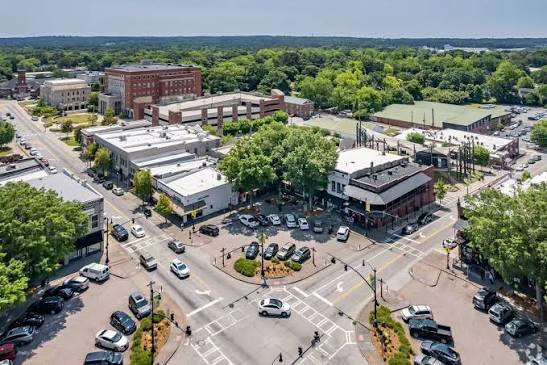
And so, because of these writings that I found lengthy and time-consuming at first ended up becoming something that brought realization into my eyes as to how I see modern public spaces, and what these authors meant when they discussed about the progress that comes along with newer developments into the urban world. From my perspective, I can see something like that occurring within Adamson Square. From what I remember during my walking tour, not only were there lots of spaces reserved for parking, which limited some areas for pedestrians, but there were also buildings that were built only to serve as parking spaces. These observations further illuminated what authors like Jane Jacobs and Rebbeca Solnit had revealed and argued for, and provided the answer to my question. Overall, the developments made in urban areas have resulted in the bulldozing of natural spaces and have limited pedestrian areas.


Leave a Reply